
From Kashi to the World: 5 Modern Ways to Style Your Ethnic Suit
Draft — For Content Manager Review
—
There is a quiet revolution happening.
It is happening in the streets of London where a young woman pairs her grandmother’s Banarasi ethnic suit with white sneakers and a leather jacket. It is happening in Tokyo where a designer layers a handwoven dupatta over a minimalist black dress. It is happening in Mumbai where women are redefining what it means to wear tradition — not as costume, but as conviction.
The world is waking up to something that Varanasi’s weavers have known for five centuries: Banarasi fabric was never meant to stay still. It was born from a fusion — Persian artistry meeting Indian craft, Mughal grandeur meeting village simplicity. It carries the soul of fusion in its very DNA.
Which means: if you have been wondering whether Banarasi ethnic suits belong in a modern wardrobe, the answer was always yes. You just needed five good reasons to believe it.
Here they are.
—
1. The Power Suit Redefined: Ethnic Meets Structured
Forget everything you think you know about “dressing up.”
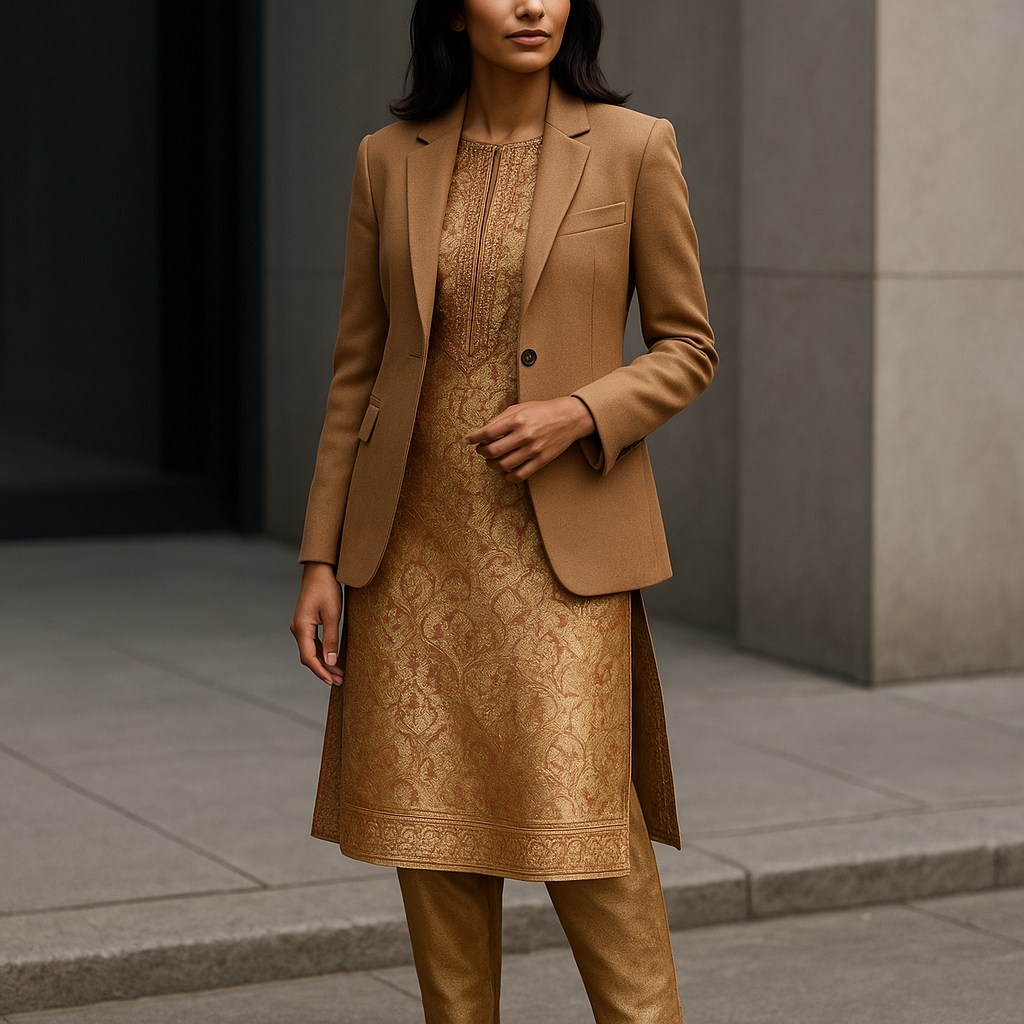
A Banarasi ethnic suit — the two-piece ensemble of kurta and bottom — has a natural elegance that modern tailoring has learned to celebrate. The solution is simple: let structure meet structure.
Pair your ethnic suit with a sharply cut blazer in camel or charcoal. The blazer adds architecture, creates a silhouette, and signals confidence — exactly what you need for that board meeting, that client dinner, that moment when you need to be taken seriously without losing yourself.
The beauty of this combination is the tension it creates. The Banarasi weave is ornate, textured, deeply detailed. The blazer is clean, precise, modern. Together they create a look that says: I carry tradition with intention, and I also carry myself with authority.
For the final touch: drop the heels. Reach for pointed-toe flats or low block heels. You do not need height when you have this much presence.
—
2. The Weekend Drift: Ethnic Suit Meets Casual Cool
You do not have to save your ethnic suit for special occasions. This is the myth we need to break.
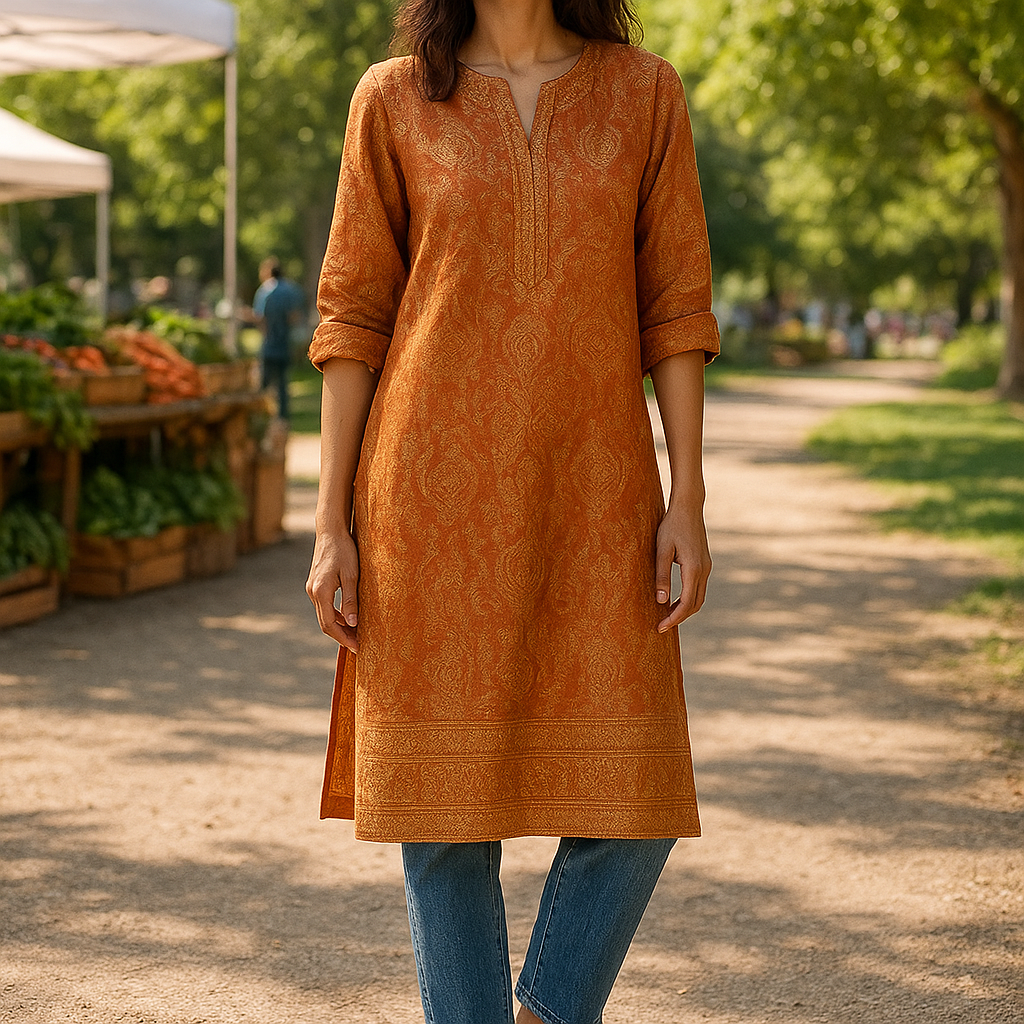
The same Banarasi ethnic suit that looks stunning at a festival looks equally at home at a weekend farmers market or a Sunday brunch. You just have to change the company it keeps.
Try this: roll the sleeves of your kurta to the elbow — casually, not carefully. Skip the traditional dupatta. Let the kurta stand alone as the statement. Pair it with straight-cut denim — not skinny jeans, straight or slightly relaxed — and simple kolhapuri slippers or minimal leather sandals.
The key word here is restraint. The ethnic suit is already doing the work. Your job is to give it room to breathe, to keep the rest of the outfit quiet so the weave can speak.
This look works because it is honest. It says: I am dressed for my life, not for a stereotype. And that kind of ease is deeply attractive.
—
3. The Layering Lesson: When Dupatta Becomes Sculpture
The dupatta is not just an accessory. In the hand of someone who knows how to wear it, it becomes architecture.
Most women treat the dupatta as a veil — something draped over the head or slung over one shoulder. There is nothing wrong with this. But there is something far more interesting you can do with it.
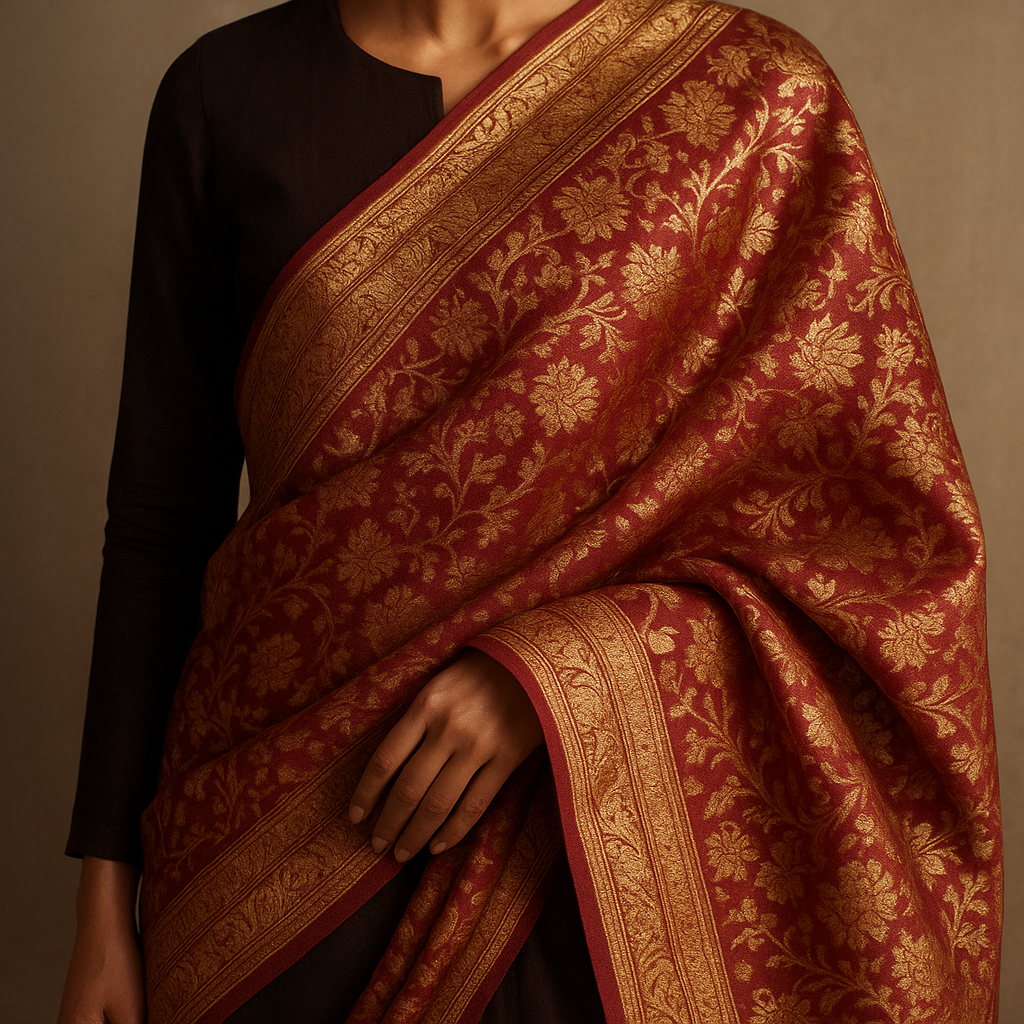
Consider the dupatta as a layering piece. Draped diagonally across the body and tucked into the waist of the ethnic suit — or of a sharp monochrome outfit — it creates a sculptural effect. The handwoven texture catches light differently across its surface, creating depth and movement that no manufactured scarf can replicate.
Try this: choose a dupatta in a contrasting color to your kurta — not clashing, but complementary. A deep burgundy dupatta over a cream or gold kurta is a classic pairing that works for almost every skin tone. Let the pallu drape diagonally, with the end allowed to fall asymmetrically. The asymmetry is modern. The fabric is ancient. That contrast is the whole point.
Bonus: this approach works even over a simple black turtleneck and cigarette pants. You do not need a full ethnic suit to make the dupatta feel intentional.
—
4. The Global Drape: Ethnic Meets International Silhouettes
Here is where imagination takes over.
A Banarasi ethnic suit does not have to follow the rules of Indian styling. The world is large, and the potential combinations are wider than you think.
Try wearing your ethnic kurta as a top over a flowing maxiskirt — yes, a maxiskirt. The kurta hem sits at the hip, the skirt pools at the floor, and the combination creates a long, dramatic silhouette that belongs on any global runway. This works especially well with lighter weight Banarasi fabrics — georgette or chiffon blends that move without bulk.
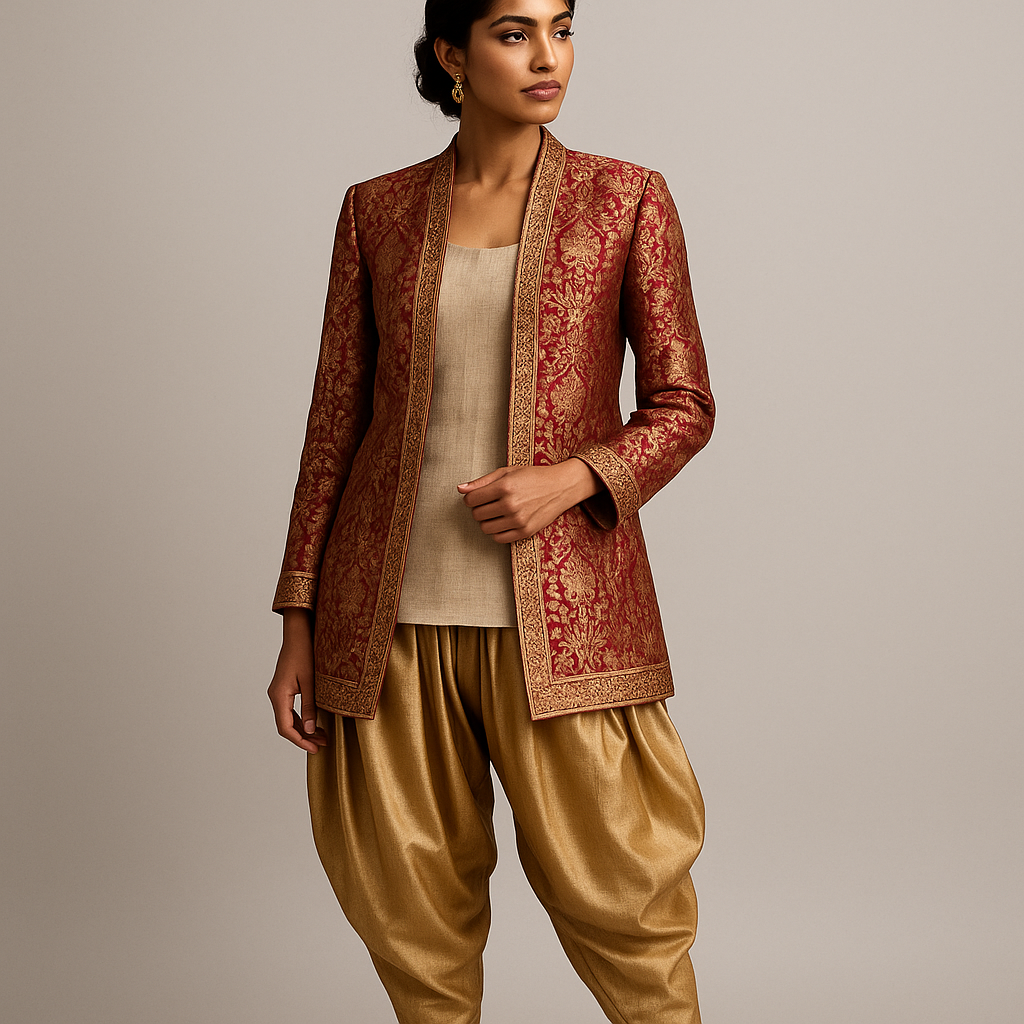
Or: wear the kurta as a jacket. Leave it open, layer it over a narrow kurta or a simple top, and let the embroidered border become the frame for everything beneath it. The embroidered border of a Banarasi kurta was made to be seen — give it that chance.
Another path: the dhoti pants. Wide, pleated, wrapped — dhoti-style bottoms have entered global fashion in a serious way, and they pair with a Banarasi kurta as though they were designed for each other. Because, in a sense, they were.
The goal is not to Westernize the ethnic suit. It is to recognize that Banarasi fabric speaks a visual language that crosses cultures fluently. It belongs to the world — you just have to give it the passport.
—
5. The Festive Moment: Tradition as Celebration, Full and Loud
Some moments deserve the full language of Banarasi.
Festive occasions — weddings, engagements, religious ceremonies, cultural celebrations — are the natural habitat of the ethnic suit. Here, restraint is not the goal. Abundance is.
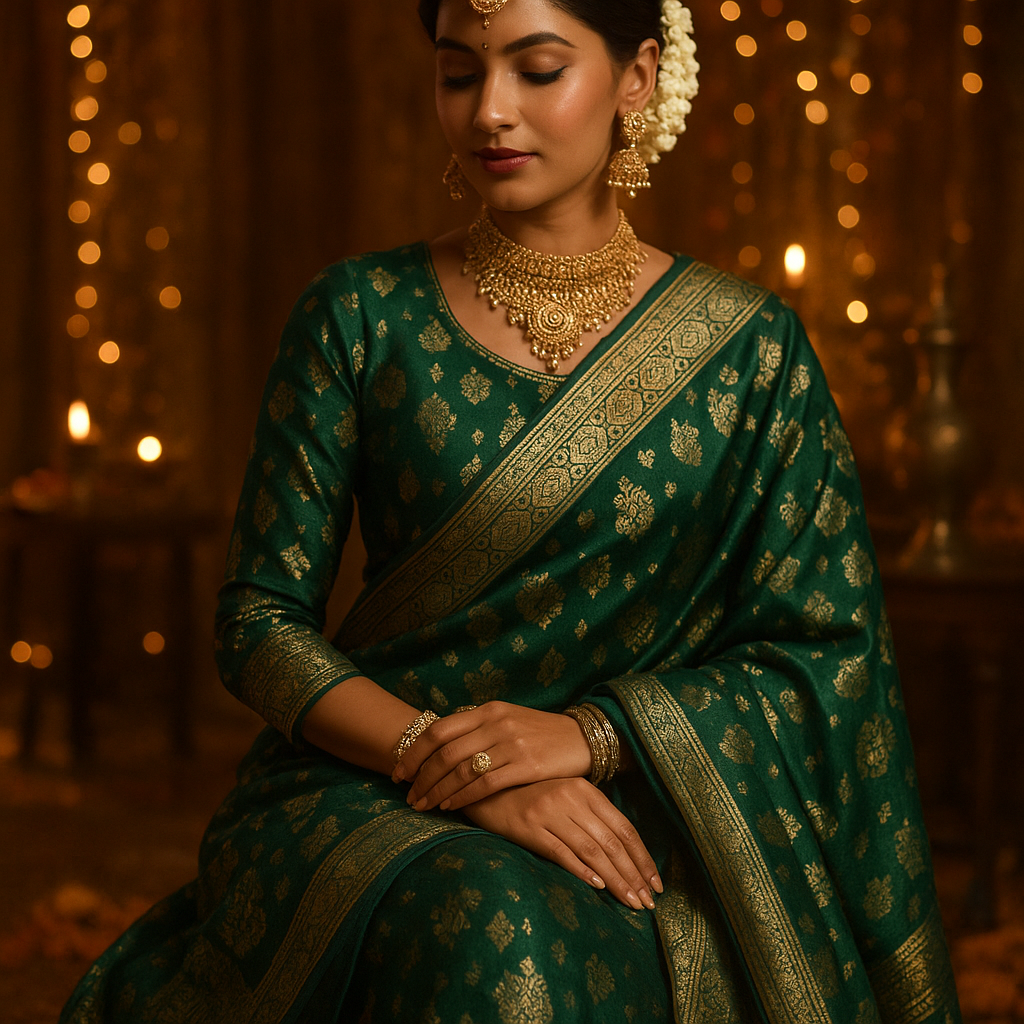
This is not the time for minimalism or clever understatement. This is the time to wrap yourself in the full glory of what Banarasi weaving offers. A richly embroidered kurta in deep jewel tones — emerald, sapphire, ruby, gold — paired with a matching or complementary bottom and the traditional dupatta draped with intention, is not “too much.” It is exactly enough.
The key to festive Banarasi styling is confidence. The fabric was designed for moments of maximum visual impact. The zari catches candlelight. The weave moves with your body. The weight of the fabric communicates presence — you are not just in the room, you are of the room.
Choose your finest Banarasi ethnic suit for these occasions and wear it without apology. Jewelry, traditional or contemporary, amplifies rather than overwhelms. The saree or ethnic suit is the canvas; the jewelry is the punctuation. Both matter.
This is heritage as celebration. This is tradition as joy.
—
The Weave Remembers: Why All of This Works
You may be wondering: is it even appropriate to style Banarasi fabric this way?
Here is what the weavers of Varanasi would tell you, if they could.
They have been adapting for five centuries. They wove for Mughal courts that demanded Persian motifs. They evolved when British textile mills threatened their survival. They innovated when synthetic fabrics flooded the market. The Banarasi weave has never been static — it has always been a living art form, absorbing influence and reinventing itself while remaining fundamentally, recognizably itself.
You are not dilute it. You are continue it.
Every time you style a Banarasi ethnic suit for a global context, every time you introduce it to a new silhouette or a new setting, you are doing what the Julaha weavers have always done: carrying craft forward without breaking its spirit.
That is not appropriation. That is inheritance.
Wear it. Make it yours. Let it travel.
Draft prepared for Content Manager review. Image placements marked. Awaiting editorial feedback before finalization.
