
How to Identify Authentic Handloom Banarasi Sarees: A Masterclass in the Art of Knowing
Draft — For Content Manager Review
—
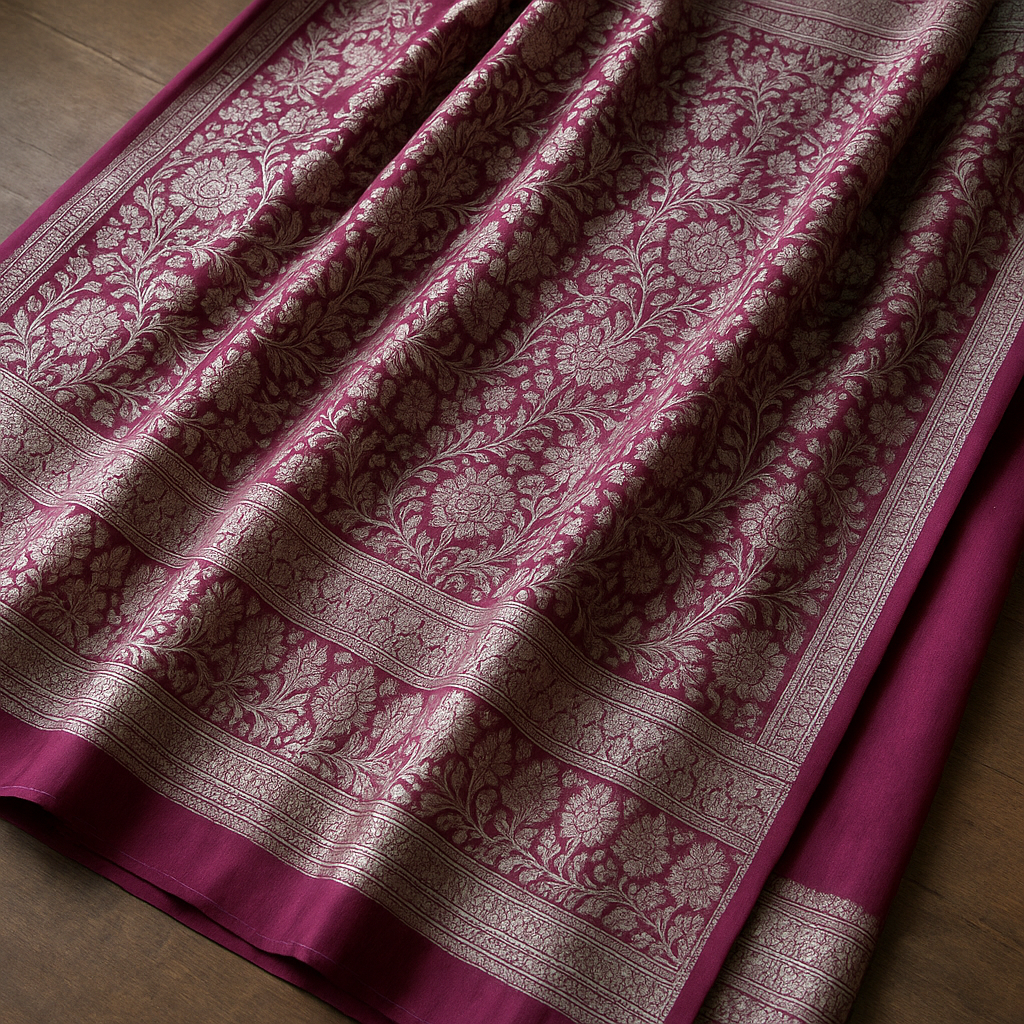
There is a moment every saree lover knows.
You are holding a piece of fabric — rich, shimmering, clearly beautiful. But something in your gut whispers a question you cannot quite voice: Is this real?
You are not alone. The market is flooded with clever copies — machine-made miracles that look the part but carry none of the soul. They are perfect in the way only things without life can be perfect. And they are sold to people who deserve better. Who deserve real.
This guide is not a lecture. It is an invitation. We are going to teach you how to read a saree the way you read a face — with attention, with patience, and with the quiet confidence that comes from knowing what to look for.
By the end, you will not just spot a fake. You will learn to feel the difference.
—
Honoring the Craft: Why Authenticity Matters
Let us begin with a truth that is easy to forget in the age of fast everything.
A real handloom saree is not a product. It is a conversation between a weaver and a loom that has lasted centuries. It carries the slight unevenness of human hands — what technicians call “irregularities” but what we call character. These are not flaws. They are proof. Proof that a person sat there, thread by thread, building something meant to outlast them.
A machine-made saree is precise. It is flawless in the way a printed photograph is flawless — technically accurate, emotionally flat. It has no story to tell because no one was there to live it.
When you choose authentic handloom, you are not just buying silk. You are casting a vote for the handmade, for the human, for the possibility that patience still matters in this world.
And we want you to make that choice with full confidence.
—
The Masterclass: Three Tests That Reveal Everything
Test One: The Reverse Side — Where the Weaver’s Truth Lives
Turn the saree over.
Yes — flip it, look at the back. This is where handloom tells its most honest story.
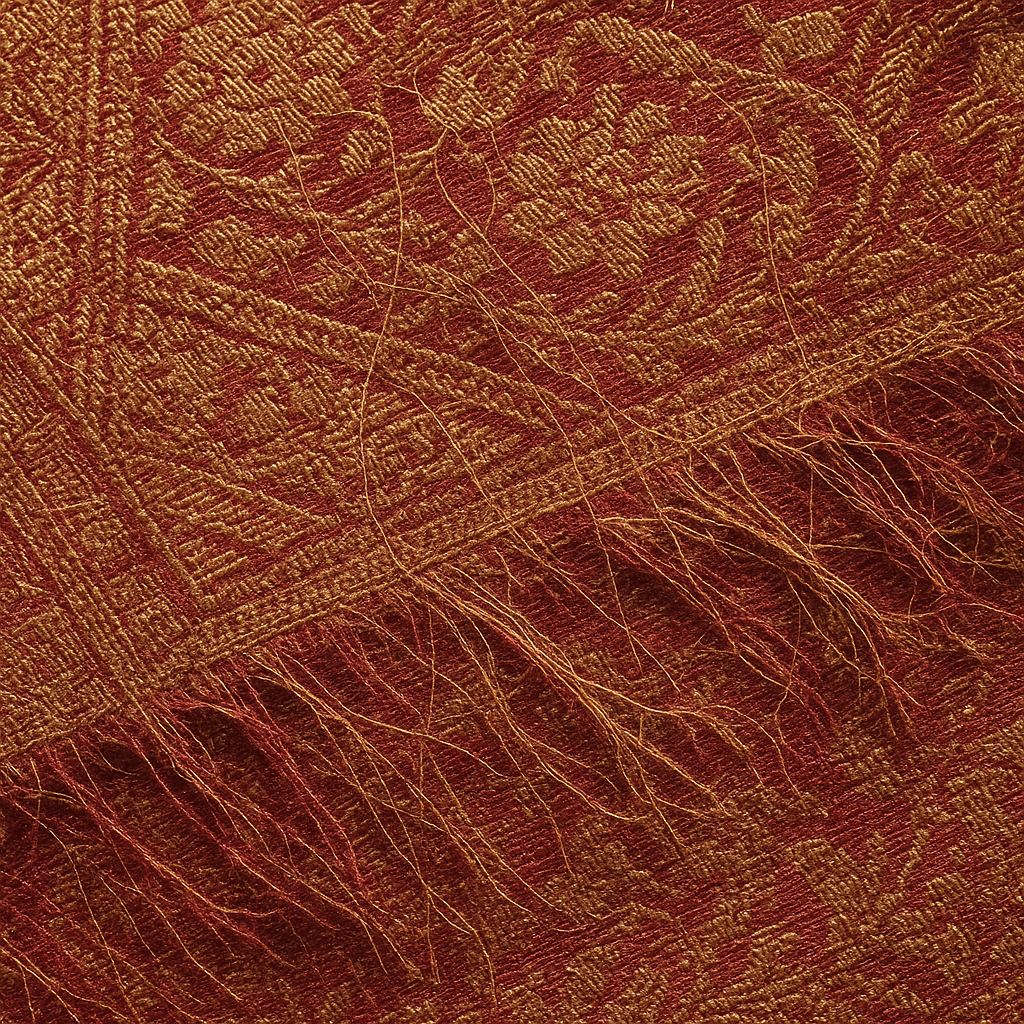
On the reverse of a true handloom Banarasi, you will notice extra threads loose in places — little floats of gold or silk that were not woven all the way through. These are the footprints of the weaver’s shuttle, the places where the thread was carried across by human hands that could not always maintain the absolute perfection of a machine.
A powerloom or machine-made saree will have a perfectly clean back — every thread locked in place, every float trimmed. Immaculate. Clinical. Cold.
Those little floats are not mess. They are memory. They are proof that your saree was born from the rhythm of a handloom, not the whir of a motor.
Look for them along the border and the pallu. If the back is suspiciously clean, your guard should go up.
—
Test Two: The Selvedge — Pin Marks and the Steady Hand
Now look at the sides of the saree — the border that runs parallel to the length.
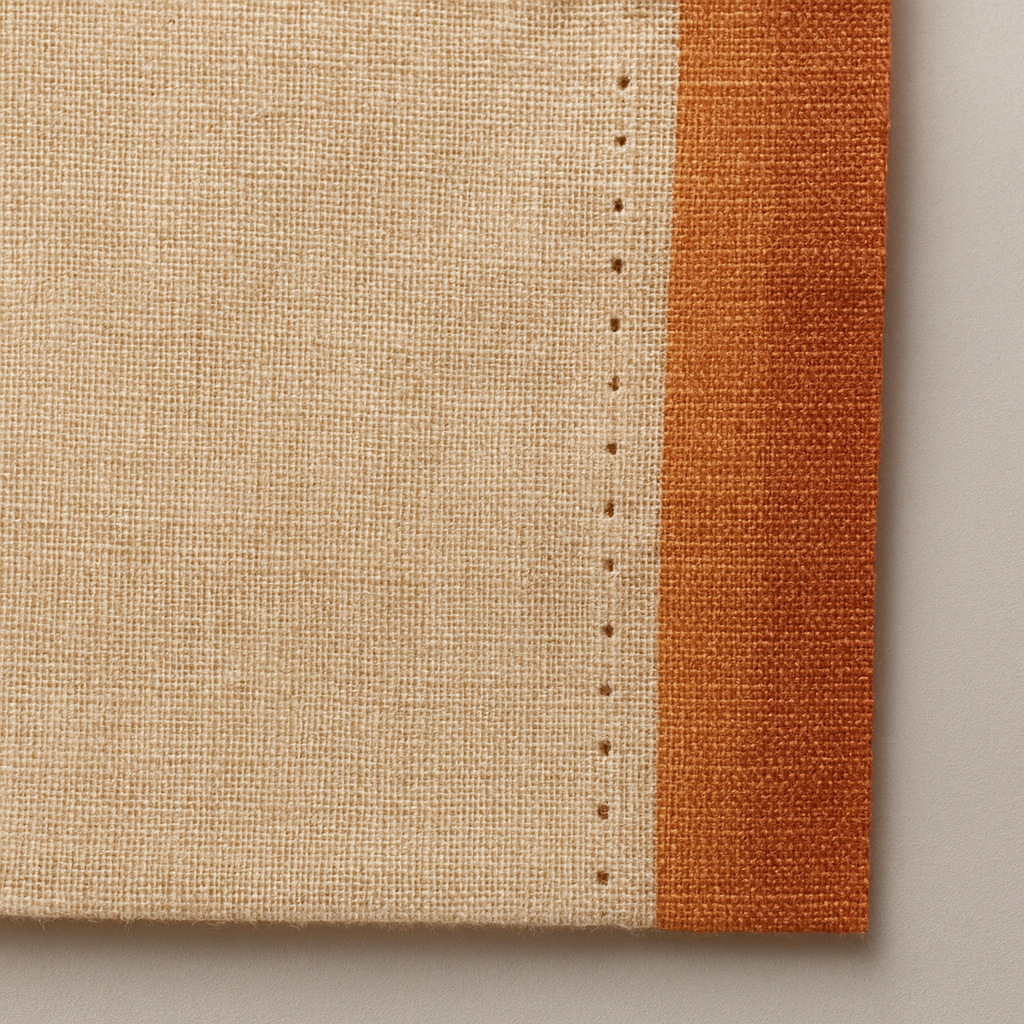
Along both edges of a true handloom Banarasi, you will notice small, evenly spaced holes. Not tears — pin marks. These are the marks left by the wooden倍 loom (called the karangi) that holds the fabric stretched taut while the weaver works. The loom pins the fabric in place, and where those pins sit, tiny holes remain.
These are not manufacturing defects. They are badges of origin.
A powerloom saree uses a different mechanism entirely — one that does not leave these pin marks. If you run your fingers along the border and find it perfectly smooth and unmarked, you are likely looking at a machine product.
The pin marks are small, subtle, and easy to miss if you are not looking. But once you know to look for them, you will never unsee them. They are the gentle signature of the wooden loom — an ancient technology still doing its quiet work in Varanasi’s weaving villages.
—
Test Three: The Burn Test — When Silk Meets Fire
This test requires a single loose thread and a flame. No more.
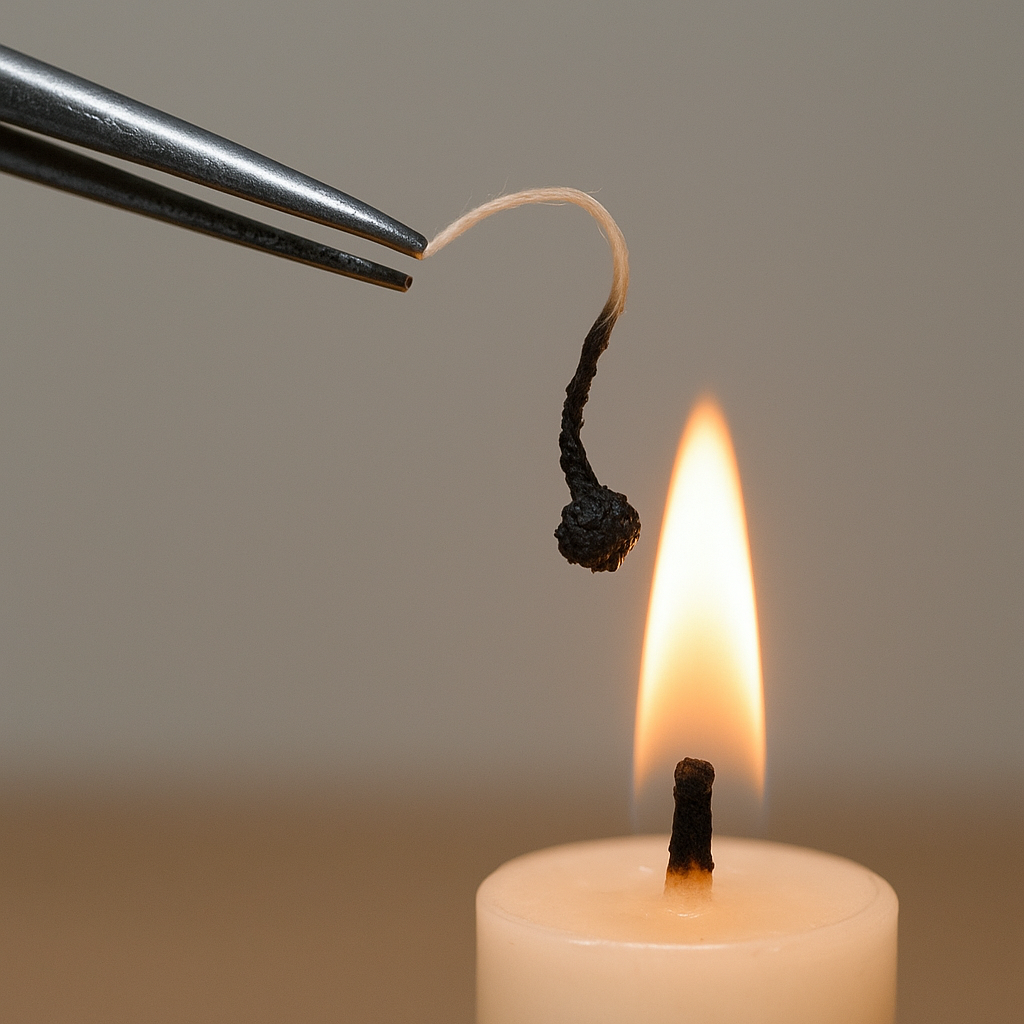
Gently pull a small thread from an inconspicuous area — the edge of the border, the hem inside the fall. Hold it with tweezers or your fingers and bring it close to a candle or lighter flame.
Pure silk burns differently than you expect.
It does not melt like plastic or catch like paper. Instead, it burns slowly with a flame, and when the flame goes out, the thread forms a brittle, blackish ball that crumbles when you pinch it. The smell — and this is the most reliable test — is unmistakable: it smells like burning human hair. This is because silk, like hair, is a natural protein fiber.
Synthetic fibers — polyester, nylon, rayon blends — behave completely differently. They melt. They shrink away from the flame. They form a hard plastic bead. And they smell like plastic too: acrid, chemical, unmistakable.
If you smell burning hair, you are holding real silk.
If you smell burning plastic, you are holding a lie.
Note: Only test a loose thread, not the main body of the saree. And be careful. A candle is all you need.
—
Investing in an Heirloom: The Zari Story
The word zari conjures images of gold. And for good reason — for centuries, the finest Banarasi sarees have featured threads of real silver and gold, hammered thin and wrapped around silk base threads to create that legendary shimmer.
But here is what the market does not want you to know: not all zari is created equal.
Real zari — what is called SD or standard zari — uses genuine silver, electroplated with gold. It is heavy, it ages beautifully, and it carries an inner warmth that catches light in a way no imitation can replicate. Over years of wear, real zari develops a patina — a depth — that synthetic versions simply cannot achieve.
Fake zari — sometimes called PD or plastic zari — is exactly what it sounds like: a塑料 coating over a base thread, designed to look like gold for a fraction of the cost. Under a microscope or even under strong light, you can often see the telltale uniformity and the plastic sheen that gives it away. And over time, it fades, cracks, and loses its luster — like a memory slowly dissolving.
How do you tell the difference without a microscope?
The weight test. Real zari is noticeably heavier than plastic zari. Pick up the pallu of the saree — if it feels substantially heavier on one end, that is a good sign. Real metallic thread adds real weight.
The light test. Hold the saree up to strong, natural light. Real zari will catch and scatter light with a warm, complex brilliance. Plastic zari tends to reflect light in a flat, harsh way — like tinsel rather than gold.
The bend test. Gently fold the zari section. Real zari holds its shape and springs back subtly. Plastic zari tends to compress permanently, showing white stress marks at the fold.
A saree with real zari is not a purchase. It is a deposit into something that will outlast you — a piece of craft that can be passed from your hands to your daughter’s hands to her daughter’s hands, still carrying the warmth of the gold.
That is the difference between buying a product and investing in an heirloom.
—
The Price as a Mirror
There is one more test, and it is the simplest of all.
Listen to the price.
A Banarasi silk saree made entirely by hand — with pure silk, real zari, and the labor of a master weaver — cannot be cheap. Not because we wish it were expensive, but because the math does not allow for cheapness. A single saree can take weeks to months to complete. The weaver’s skill, the quality of materials, the time invested — all of this has a cost that no shortcut can eliminate.
If a Banarasi silk saree is priced at what seems like a “too good to be true” number, it is because it is exactly that.
This does not mean every expensive saree is real — there are plenty of overpriced fakes. But a rock-bottom price is a guaranteed signal that corners were cut somewhere. Machine production, synthetic silk, plastic zari — these are the ingredients of a cheap saree disguised as a premium one.
Fair prices reflect fair craft. When you pay fairly, you are not just buying a saree. You are paying the rent of a weaver’s family. You are honoring the cost of skill that took a lifetime to develop. You are keeping the loom alive.
We believe in transparent pricing. We believe you deserve to know what you are paying for and who you are paying it to. When you choose Nisa Silk Fab, you are choosing a direct relationship with craft — no middlemen, no mysteries, just the honest cost of real handmade silk.
—
Your Confidence, Their Legacy
You have now learned things that most shoppers never take the time to discover.
You know how to read the back of a saree for floats. You know to look for pin marks along the selvedge. You know the burn test, the weight test, the light test, the bend test. You know how to tell real zari from plastic.
This knowledge is not just power for you — it is protection for the craft. Every time you refuse to accept a fake, every time you ask the right questions and notice the right details, you are casting a vote for authenticity. You are telling the market that there are buyers who care, who notice, who will not be fooled.
And that matters more than you know.
The Julaha weavers of Varanasi have survived empires, political upheaval, economic hardship, and the relentless pressure of fast fashion. They survive because people like you — people who care about soul over speed, about character over perfection — keep choosing the real thing.
Thank you for taking the time to learn the difference. Thank you for investing in craft that deserves it.
Your saree is out there. Real, handwoven, and waiting for hands that will know its worth.
Draft prepared for Content Manager review. Image placements marked. Awaiting editorial feedback before finalization.
