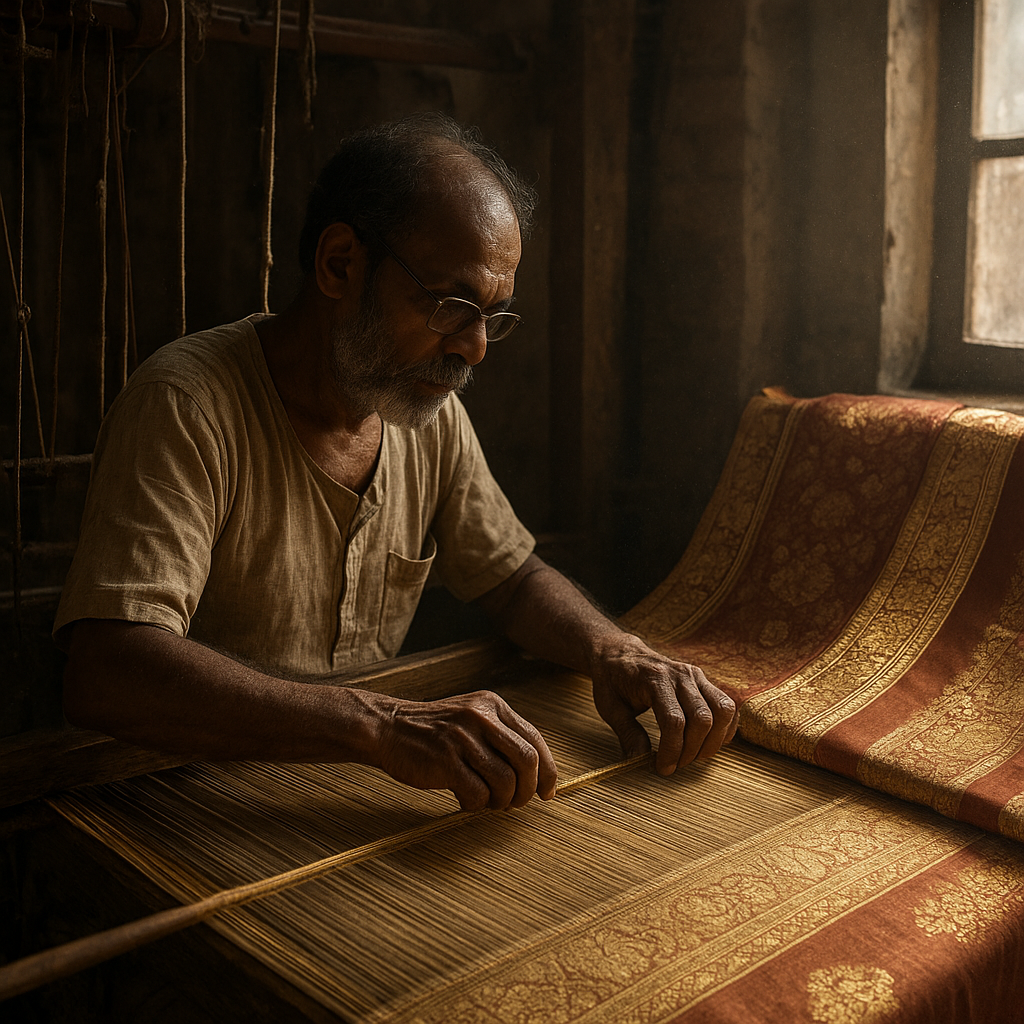
On the first morning, the weaver sits in silence before the empty loom. There is a prayer — the same one our weavers have said for generations. The warp has been prepared the night before — 1680 threads of pure Katan silk, each one twisted by hand to a precise thickness. To touch them is to understand why we call silk "the patient cloth."
Day two to five is the warp-drawing. Each of the 1680 threads must be threaded through the heddles — small wire eyes that lift alternate threads to create the weave. A single mis-threaded warp will ruin 21 days of work. We do this in the morning light, when the eyes are freshest.
Day six, the weaving begins. The shuttle — a small boat of carved rosewood — carries the weft thread back and forth, building the cloth one row at a time. A skilled weaver completes 8 to 12 centimeters per day. The pace is set not by ambition but by the silk itself, which tears if rushed.
Day seven to fifteen is the body. The plain silk of the saree grows slowly, row by row. This is when the weaver listens — to the rhythm of the loom, to the creak of the wood, to the small corrections the silk demands. A master weaver does not look at the cloth often; he feels it.
Day sixteen is the day the pallu begins. The pallu is the decorated end of the saree — the part that shows when worn. It is woven with the kadhwa technique, in which each motif is tied by hand, thread by thread, like a knot garden. A 30-centimeter pallu takes five days.
Day sixteen to twenty is the pallu. This is when the master weaver works alone, often at night, when the atelier is quiet. The motifs are tied from memory — there are no printed patterns. A single motif, the size of a thumb, can take three hours to tie.
Day twenty-one is the cutting. The saree is lifted from the loom and laid flat. The weaver examines every centimeter in daylight, marking any imperfection with a small white thread. Imperfections are not flaws — they are the proof of the hand. But the weaver marks them anyway, because he will know.
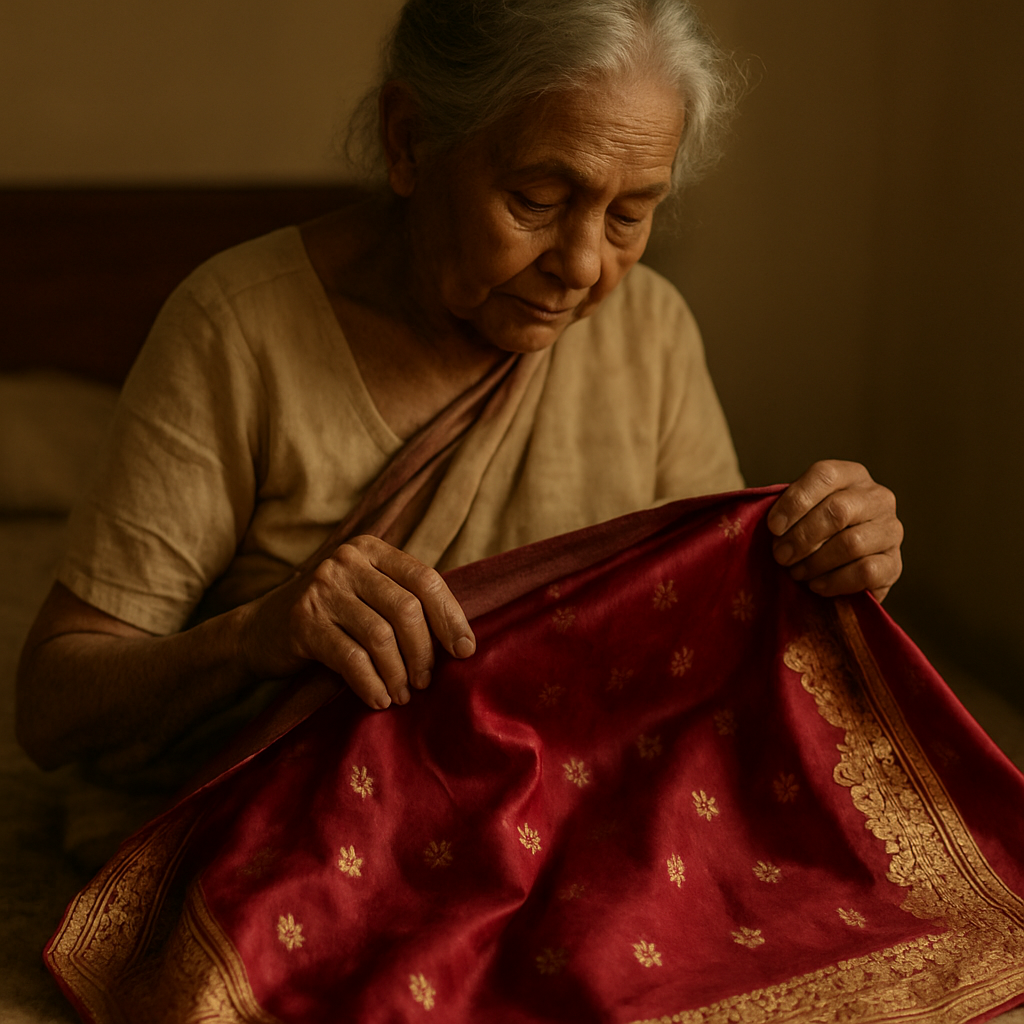
The saree then goes to the dyer, the fall-stitcher, and the pico-hand. Another ten days. From loom to wardrobe, a single Katan saree takes about 31 days. We sell it for what it costs, plus a small margin that keeps the atelier alive.
Twenty-one days for one saree. It is not slow. It is the speed of silk.