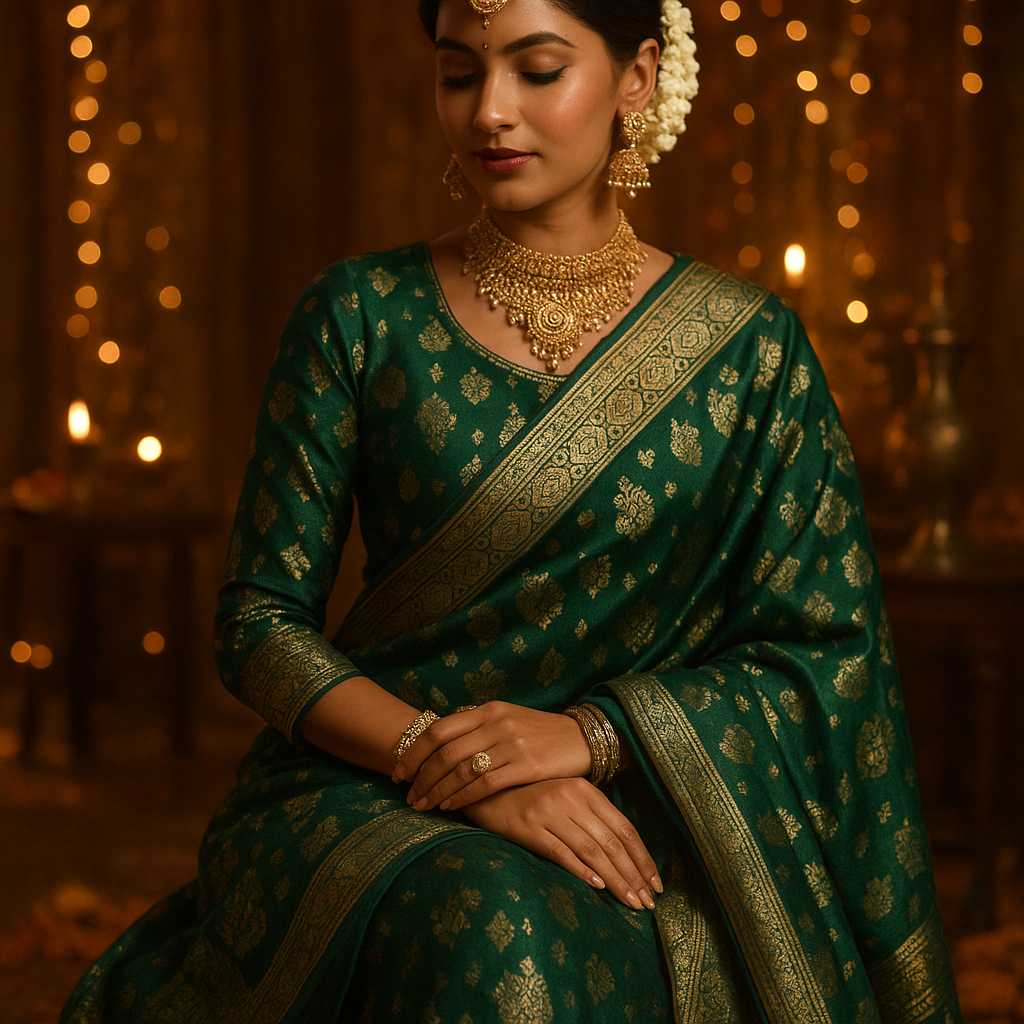
You bought a Banarasi silk saree. The seller said it was pure silk. The label says “100% pure silk.” The price felt right. You brought it home, wore it once, and something about it does not sit well.
Maybe the fabric feels too slippery. Maybe the shine is too uniform. Maybe you noticed the zari peeling at the edges after one wash. Maybe you are just not sure.
This guide gives you seven tests — from the quick-and-simple to the definitive — that will tell you whether your Banarasi silk is the real thing or a convincing imitation. Some of these tests take five seconds. One of them requires sacrificing a single thread. All of them are reliable.
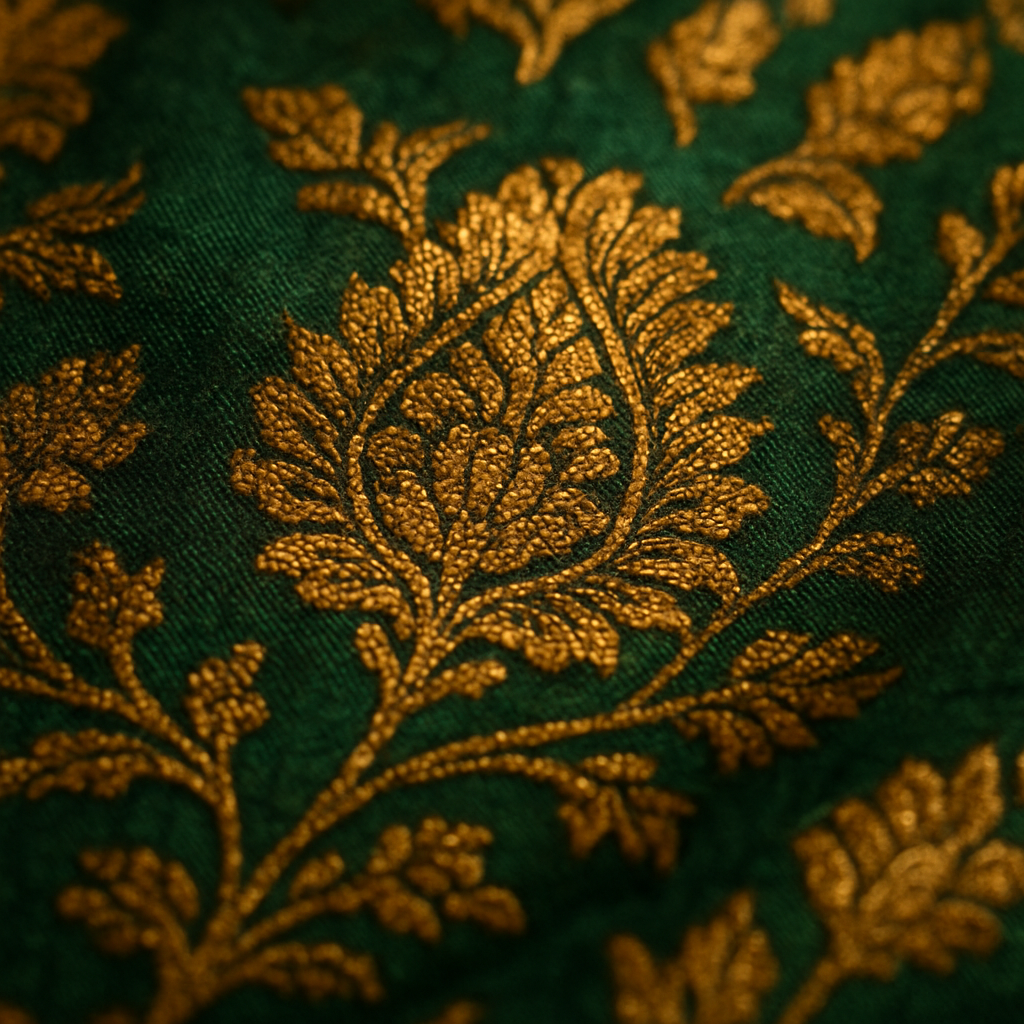
Test 1: The Touch Test (5 seconds)
Pure silk is a protein fibre — the same molecular structure as human hair. When you hold it against your cheek or the inside of your wrist, it warms up within two to three seconds. It has a slight drag, a texture that grips the skin gently.
Art silk (rayon, polyester, viscose) is synthetic. It stays cool against the skin. It slides. It feels slick, almost plasticky.
How to do it: Close your eyes. Press the fabric against your cheek for five seconds. If it warms up, it is likely pure silk. If it stays cool and slippery, it is likely synthetic.
Test 2: The Ring Test (10 seconds)
Pure silk yarn is extraordinarily fine — about 11 to 13 microns in diameter, thinner than a human hair. Art silk yarn is typically 30+ microns. This means pure silk fabric can pass through a small opening that art silk cannot.
How to do it: Take a gold or silver finger ring. Pull a corner of the saree fabric through the ring. Pure silk passes through smoothly, with almost no resistance. Art silk catches, squeaks, or requires force.
This test works because the weave of pure silk is tighter and the individual threads are finer. If the fabric resists the ring, the yarn is too thick to be pure silk.
Test 3: The Luster Test (15 seconds)
Pure silk has a deep, soft, almost liquid sheen. The light seems to come from inside the fabric. When you tilt the saree under a lamp, the color shifts subtly — darker at one angle, lighter at another.
Art silk has a hard, surface-level shine. It looks the same from every angle. The light bounces off the surface rather than penetrating the fibre.
How to do it: Hold the fabric under a light source. Tilt it back and forth slowly. If the sheen deepens and shifts, it is pure silk. If it looks like a glossy magazine page — flat, uniform, hard — it is art silk.
Test 4: The Wrinkle Test (20 seconds)
Pure silk fibres have low resilience. They hold the shape you give them. When you crush pure silk in your fist and release, it wrinkles — and the wrinkles stay for several seconds before slowly relaxing.
Art silk (especially polyester) has high resilience. It bounces back almost instantly, leaving no crease.
How to do it: Crush a small section of the fabric in your fist for five seconds. Release. If the fabric stays wrinkled, it is pure silk. If it springs back smooth, it is synthetic.
Counterintuitively, the fabric that never wrinkles is the fake one. Pure silk is alive — it remembers what you do to it.
Test 5: The Zari Scratch Test (30 seconds)
The zari (metallic thread) used in Banarasi sarees comes in three grades. This test tells you which one you have.
How to do it: Turn the saree inside out. Find a section of zari on the reverse. Scratch it gently with your fingernail.
- Pure gold zari (Rs 15,000+ sarees): The scratch reveals a silver core. The gold does not come off. The thread feels like real metal.
- Real zari / tested zari (Rs 3,000 to Rs 15,000): The scratch reveals a copper or silver core. The gold plating may flake slightly but the thread underneath is metallic.
- Fake zari / printed foil (Rs 500 to Rs 2,000): The scratch reveals white fabric. The “zari” is printed foil on the surface, not woven metallic thread.
If your scratch test reveals white fabric underneath the gold, your saree is not handloom Banarasi. It is a printed power-loom copy.
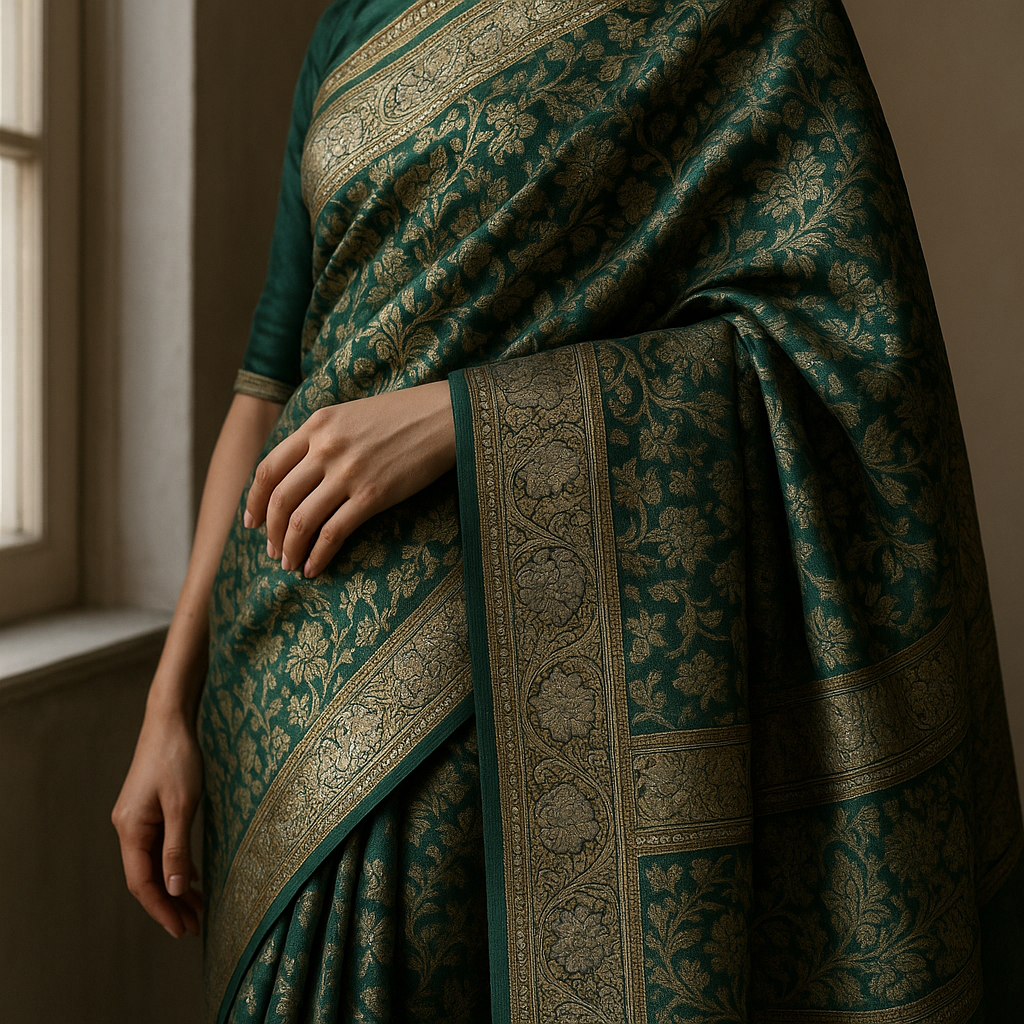
Test 6: The Burn Test (30 seconds, requires one thread)
This is the definitive test. It requires pulling a single thread from the inner seam of the saree (where the cut will not be visible) and burning it with a match or lighter.
| Material | Smell | Ash | Flame |
|---|---|---|---|
| Pure silk | Burnt hair | Black, brittle, crumbles to powder | Slow, self-extinguishing |
| Art silk (rayon) | Burnt paper | Soft grey ash | Fast, steady |
| Polyester | Plastic / chemical | Hard black bead, does not crumble | Black smoke, melts |
| Cotton blend | Burnt paper | Soft grey ash, no bead | Fast, even |
The burnt-hair smell is the giveaway. Pure silk is a protein (like hair, like wool, like nails). When it burns, it smells like burning protein. If your thread smells like plastic or paper, it is not pure silk.
Test 7: The Price Test (5 seconds, no equipment needed)
This is the test most buyers skip, and it is the most reliable indicator of all.
The cost breakdown of a genuine handloom Banarasi silk saree is approximately:
| Component | Cost (Rs) |
|---|---|
| Silk yarn (pure mulberry) | 400 to 600 |
| Zari (real or tested) | 300 to 800 |
| Weaver wage (handloom) | 800 to 3,000 |
| Dyeing + finishing | 100 to 200 |
| Packaging + transport | 50 to 100 |
| Minimum total cost | 1,650 to 4,700 |
If a “pure silk Banarasi saree” is priced at Rs 699, Rs 899, or Rs 1,299, it is mathematically impossible for it to be genuine handloom pure silk. The raw materials alone cost more than the selling price.
This does not mean cheap sarees are bad. Art silk and power-loom sarees are legitimate products at legitimate price points. But they should be sold as art silk and power-loom, not as pure handloom silk.
What to Do If Your Saree Fails
If you have run these tests and your saree is not what the seller claimed, you have three options:
- Contact the seller. Honest sellers will offer a refund or exchange. Dishonest sellers will not — which tells you everything you need to know.
- Report to the Silk Mark Organisation. If the seller claimed Silk Mark certification and the saree is not pure silk, file a complaint with the Central Silk Board.
- Leave a review. Other buyers deserve to know. This is the most powerful tool against misrepresentation in the silk industry.
Frequently Asked Questions
Can I do the burn test without damaging the saree?
Yes. Pull one single thread from the inner seam (the part that gets tucked into the petticoat). The hole will be invisible. One thread is enough for the test.
What is Silk Mark certification?
Silk Mark is a certification scheme by the Silk Mark Organisation of India (under the Central Silk Board). It guarantees that the fabric is pure silk. Look for the hologram label on the saree.
Are all power-loom sarees fake?
No. Power-loom sarees can use pure silk yarn. They are faster and cheaper to produce, but the silk itself can be genuine. The issue is when power-loom sarees are sold as handloom (which is a legal and ethical violation, not a quality issue).
Where can I buy certified pure silk Banarasi sarees?
Our saree collection is sourced directly from weaver families in Varanasi. Every piece is handloom and carries Silk Mark certification where applicable. We list the silk type, zari grade, and weave time transparently on every product page.
Still unsure about your saree? Send us a photo — we will tell you honestly what you are looking at, even if you did not buy it from us.