A buyer's guide written by people who actually weave these sarees.
If you have ever stood in a Banarasi saree shop — or scrolled through an Instagram page selling them — and wondered why one piece costs Rs 1,800 and another that looks almost identical costs Rs 18,000, you are not alone. The price gap is real, and most of it is invisible to the untrained eye.
This guide breaks down what a Banarasi silk saree should actually cost in 2026, what drives that cost, and how to know whether you are paying for craft or paying for marketing.
The Honest Price Range (and What Each Tier Buys You)
Let us start with the numbers. As of 2026, a genuine Banarasi silk saree in India falls into one of four broad price tiers. Each tier reflects specific choices about silk, zari, weave, and labour.
Tier 1: Rs 1,500 – Rs 3,000 (Entry-Level Handloom)
At this price, you should expect pure mulberry silk but with simpler designs. The zari is often tested zari (copper core with gold plating) rather than real gold. Weaving time is 3–5 days per saree. These are excellent daily-wear and festive sarees — they look rich, age well, and do not require second-mortgage-level care. Our entry-level Banarasi sarees sit here.
What to check: the silk should feel crisp, not slippery. The reverse of the saree should show the weave clearly (not be flat or printed). The pallu should have visible handwoven detail, even if the design is simple.
Tier 2: Rs 3,000 – Rs 7,000 (Mid-Range Katan Silk)
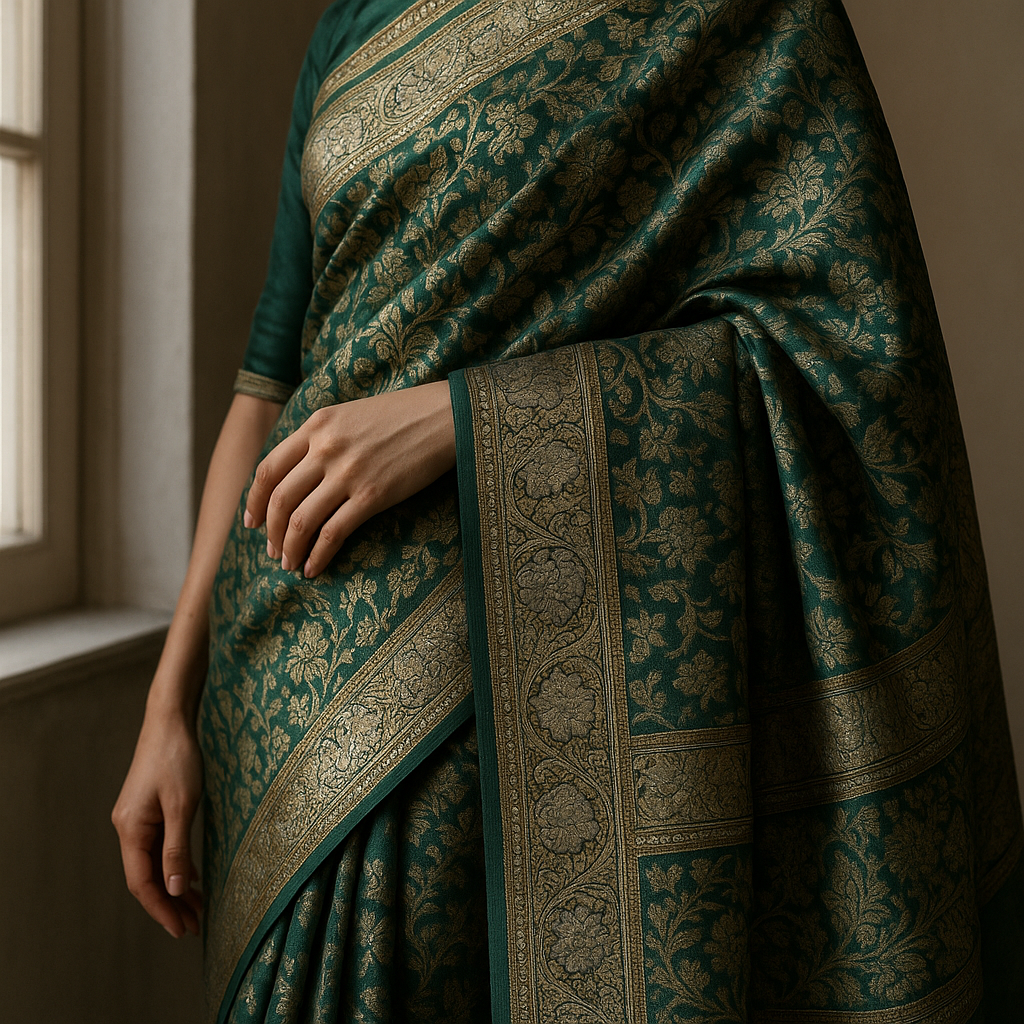
This is where Banarasi silk gets serious. You are paying for katan silk (a denser, more lustrous silk yarn) and real zari work. Weaving time jumps to 7–14 days. Designs include intricate butta work, jall patterns, and meena weaving. This is the sweet spot for wedding guests, festive occasions, and women who want one heirloom-quality piece without breaking into five figures.
What to check: hold the saree up to light. The silk should have a deep, almost liquid sheen. The zari should feel slightly rough to the touch (real zari is metallic thread, not printed foil). The border should be woven into the fabric, not stitched on.
Tier 3: Rs 7,000 – Rs 15,000 (Premium Katan with Heavy Zari)
At this tier, you are buying a piece that took a master weaver 15–30 days to complete. The zari is real gold-plated on silver wire. The designs are intricate — full jall work, complex butta arrangements, multi-colour meena. These are trousseau sarees, milestone-birthday sarees, and pieces that will be passed down a generation.
What to check: the saree should come with a Silk Mark certification (a hologram sticker from the Silk Mark Organisation of India). The weaver's name or workshop should ideally be traceable. The weight should feel substantial — a real katan silk saree with heavy zari weighs 600–800 grams.
Tier 4: Rs 15,000 – Rs 25,000+ (Bridal and Museum-Grade)
This is the top of the craft. A single saree can take 30–90 days to weave. The zari is genuine gold thread (often 1–2 grams of real gold per saree). The designs reference specific Mughal or Persian motifs, sometimes recreating pieces from museum collections. Weaving families often have only one or two master weavers capable of this work.
What to check: the price should include a certificate of authenticity, the weaver's name, and the silk mark. The saree should be packaged in a breathable muslin cloth, not plastic. We do not currently stock this tier on our site — these are commissioned directly with master weaver families.
What Actually Drives the Price
Five factors decide where a saree sits in the tiers above. Understanding them is the difference between buying craft and buying confusion.
1. Silk Quality (20–30% of cost)
The silk yarn itself is graded by denier (thickness) and origin. Mulberry silk from Karnataka is the industry standard. Katan silk is a denser yarn that takes more raw material per metre. The difference between a Rs 2,000 and Rs 5,000 saree is often silk quality — the cheaper one uses lower-denier yarn that looks fine but lacks the depth of sheen.
2. Zari Quality (25–35% of cost)
Zari is the metallic thread used for the gold/silver work. There are three grades:
- Tested zari – copper wire electroplated with gold. Used in Rs 1,500–Rs 3,000 sarees. Looks gold, ages to bronze.
- Real zari – silver wire electroplated with gold. Used in Rs 3,000–Rs 15,000 sarees. Holds its gold tone for decades.
- Pure gold zari – actual gold thread on silver wire. Used in Rs 15,000+ sarees. Holds value as a precious metal.
3. Weaving Time (30–40% of cost)
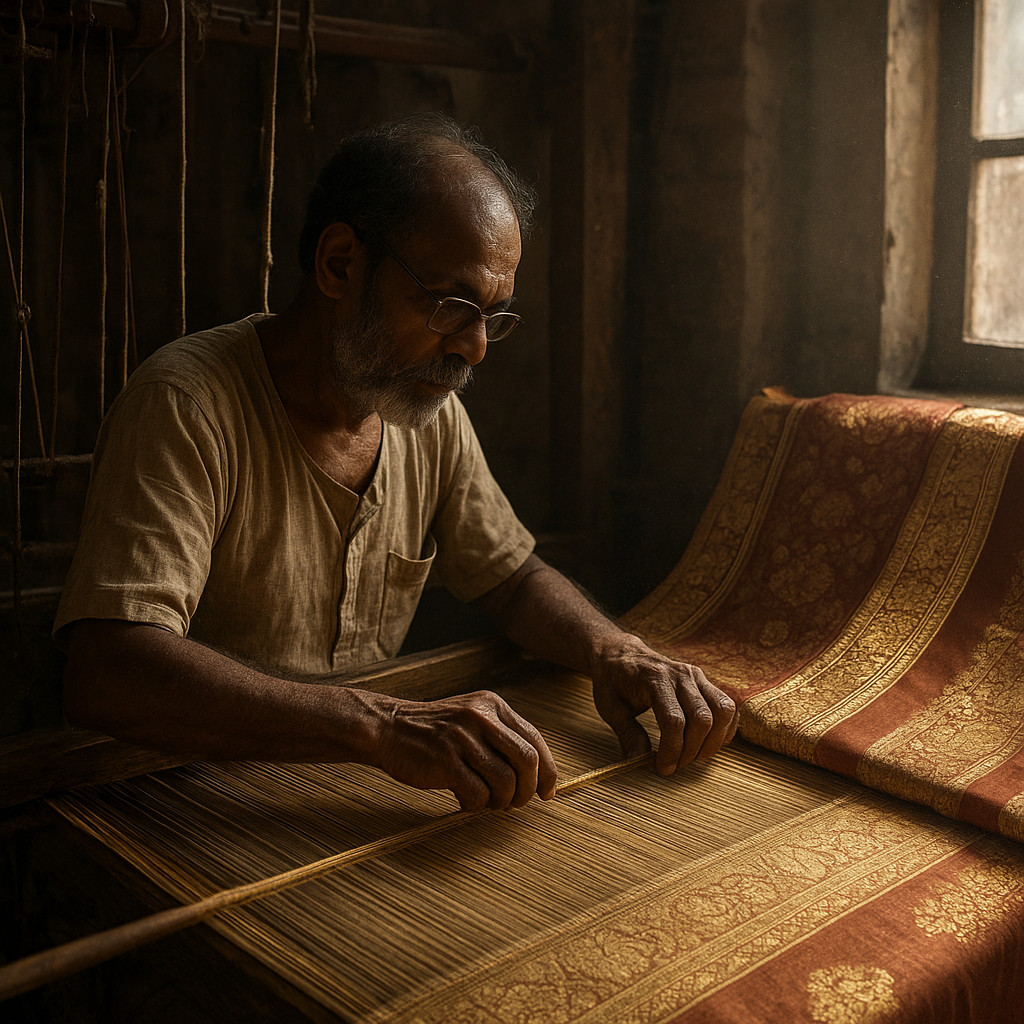
A power-loom saree takes 2–3 hours to produce. A handloom saree takes 3–90 days. The weaver's daily wage is the single largest cost component of any genuine handloom piece. This is why two visually similar sarees can have a 5x price difference — one was made by a machine, the other by a person.
4. Design Complexity (10–15% of cost)
A simple butta design (small motifs scattered across the body) is faster to weave than a full jall (all-over intricate pattern). Multi-colour meena work — where the weaver introduces coloured silk threads between zari lines — is the most time-consuming of all.
5. Origin and Certification (5–10% of cost)
A GI-tagged Banarasi saree (Geographical Indication) is certified as genuinely woven in the Varanasi region. Silk Mark certification guarantees pure silk. These certifications add cost but also add resale value and trust.
The Fake Price Trap: When Cheap Is Too Cheap
If you see a "pure Banarasi silk saree" for Rs 800 online, it is almost certainly one of three things:
- Art silk (synthetic) — looks like silk, feels slippery, melts if you test it with a flame.
- Power-loom with handloom finish — machine-woven base with hand-stitched border. Sold as "handloom" but legally it is not.
- Surat-made replica — printed or jacquard-woven in Surat, marketed as Banarasi. Beautiful, but not the real thing.
None of these are inherently bad — art silk has its place, power-loom makes silk accessible, and Surat replicas are pretty. The problem is when they are sold as genuine handloom Banarasi at prices that suggest they are.
How to Test If You Got What You Paid For
Three quick tests, in order of destructiveness:
- The burn test – pull one thread from the inner seam and burn it with a match. Pure silk smells like burnt hair and leaves a brittle black ash. Art silk smells like plastic and melts into a hard bead.
- The ring test – pull the saree through a finger ring. Pure silk, being fine, passes through smoothly. Art silk, being thicker, catches.
- The zari test – scratch the zari gently with a fingernail on the reverse. Real zari reveals a silver core. Tested zari reveals copper. Printed zari reveals white fabric.
If your Rs 5,000 saree fails the burn test, you overpaid by about Rs 4,200.
Frequently Asked Questions
What is the minimum price for a real Banarasi silk saree?
Around Rs 1,500–Rs 2,000 for an entry-level handloom piece with tested zari. Anything cheaper is either art silk, power-loom, or a non-Banarasi replica.
Why are some Banarasi sarees Rs 50,000?
Those sarees use real gold zari (1–2 grams of gold), take 30–90 days for a master weaver to complete, and are often one-of-a-kind commissioned pieces. The gold content alone can account for Rs 8,000–Rs 15,000 of the price.
Is a Rs 5,000 Banarasi saree worth it?
If it is genuine handloom katan silk with real zari, yes — this is the sweet spot for quality and value. You get a piece that will last 15–20 years with proper care and become an heirloom.
How do I know if a Banarasi saree is handloom?
Look for the Silk Mark hologram, slight irregularities in the weave (proof of human hands), and a hand-stitched border. The reverse of a handloom saree shows the pattern clearly; the reverse of a power-loom piece is flatter.
Where can I buy authentic Banarasi silk online?
Our Banarasi silk saree collection is sourced directly from weaver families in Varanasi. Every piece carries Silk Mark certification where applicable, and we list the silk type, zari grade, and weave time transparently.
This guide was written by the team at Nisa Silk Fab. We have been weaving and selling Banarasi silk for over 25 years. If you have a question about a specific saree — ours or someone else's — send us a message and we will tell you honestly what you are looking at.