A Banarasi saree travels further than most people. Before it reaches your wardrobe, it passes through six pairs of hands, three cities, and a supply chain that has not fundamentally changed in four hundred years. This is the story of that journey — from a silk cocoon in Karnataka to a handloom in Varanasi to a parcel arriving at your door.
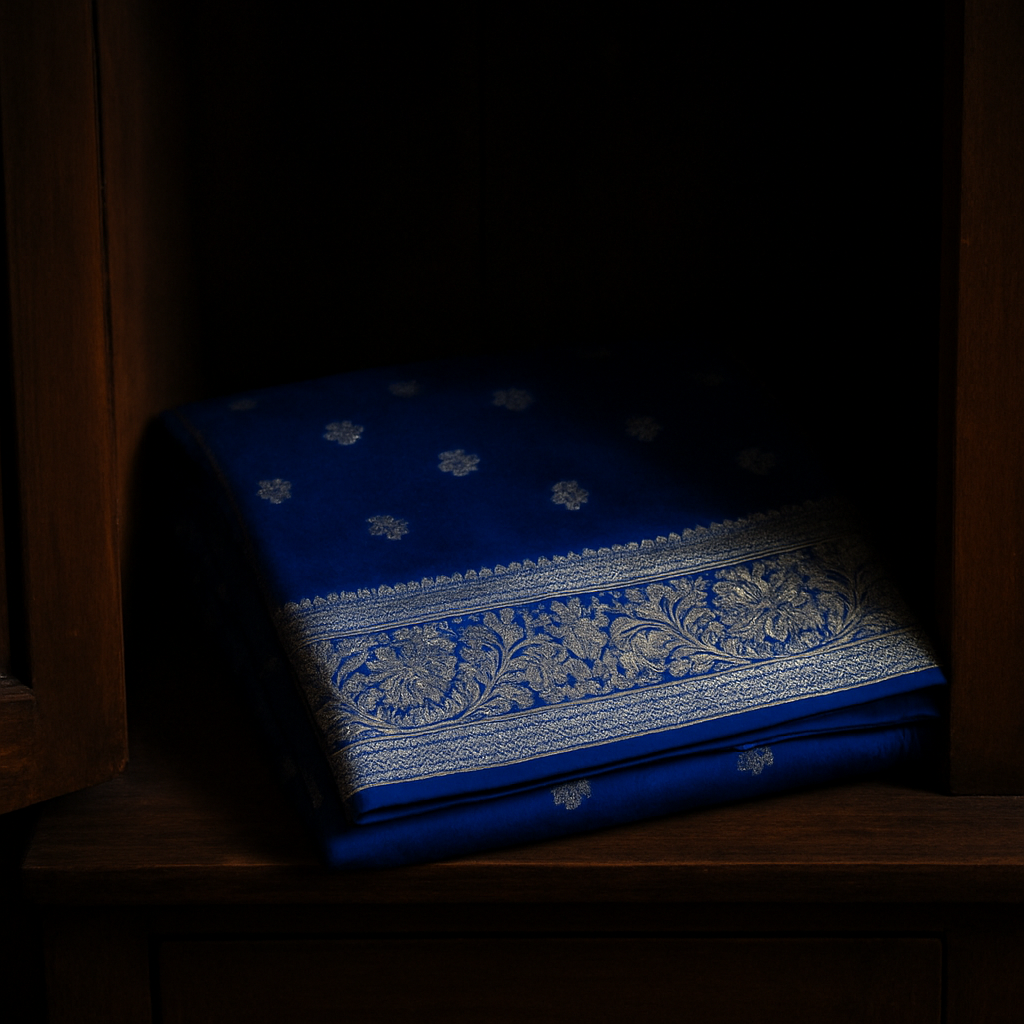
Stage 1: The Silk Farm (Karnataka)
Every Banarasi saree begins as a cocoon. The silk yarn used in Banarasi weaving comes from mulberry silkworms — Bombyx mori — raised primarily in Karnataka, Andhra Pradesh, and Tamil Nadu. The silkworms are fed mulberry leaves for twenty-five to thirty days, after which they spin cocoons of continuous silk thread measuring 700 to 1,500 metres each.
The cocoons are harvested, boiled (to kill the pupa and loosen the sericin gum), and the thread is reeled onto spools. This raw silk is called reeled silk or filature silk, and it is sold by weight to yarn processors.
Cost at this stage: Rs 2,800 to 3,500 per kilogram of raw silk yarn.
Stage 2: The Yarn Processor (Surat or Varanasi)
The raw silk yarn is too coarse for weaving. It must be processed:
- Twisting: Two or more yarns are twisted together to create a stronger, denser thread. For katan silk (the densest Banarasi fabric), the yarn is twisted 80 to 100 turns per metre. For organza, it is barely twisted at all.
- Dyeing: The yarn is dyed in large vats using acid dyes (for silk) or natural dyes (for premium pieces). A single dye batch takes four to six hours and must be matched precisely to the designer’s color specification.
- Drying and winding: The dyed yarn is dried in shade (direct sunlight fades the color) and wound onto bobbins for the weaver.
Cost at this stage: Rs 4,000 to 5,500 per kilogram of processed katan silk yarn. A single saree requires 150 to 250 grams of silk.

Stage 3: The Zari Maker (Surat)
The zari — the metallic thread that gives Banarasi sarees their gold and silver work — comes from Surat. Surat has been the center of zari manufacturing in India for over 300 years, and the process is remarkable:
- Copper wire drawing: A thick copper wire is drawn through progressively smaller dies until it is the thickness of a human hair (0.05 to 0.1 mm).
- Silver coating: The copper wire is electroplated with a layer of pure silver. This is what gives the zari its silver core.
- Gold plating (for real zari): The silver-coated wire is then electroplated with a thin layer of gold (24 karat). This is the “real zari” used in sarees above Rs 5,000.
- Flattening: The round wire is flattened into a ribbon-like thread that can be woven on a loom.
- Spooling: The flattened zari is wound onto small spools that the weaver places in the loom’s shuttle.
Cost: Tested zari (copper + silver, no gold) costs Rs 400 to 600 per 100 grams. Real zari (with gold plating) costs Rs 1,200 to 2,500 per 100 grams. A single saree uses 50 to 150 grams of zari.
Stage 4: The Weaver (Varanasi)
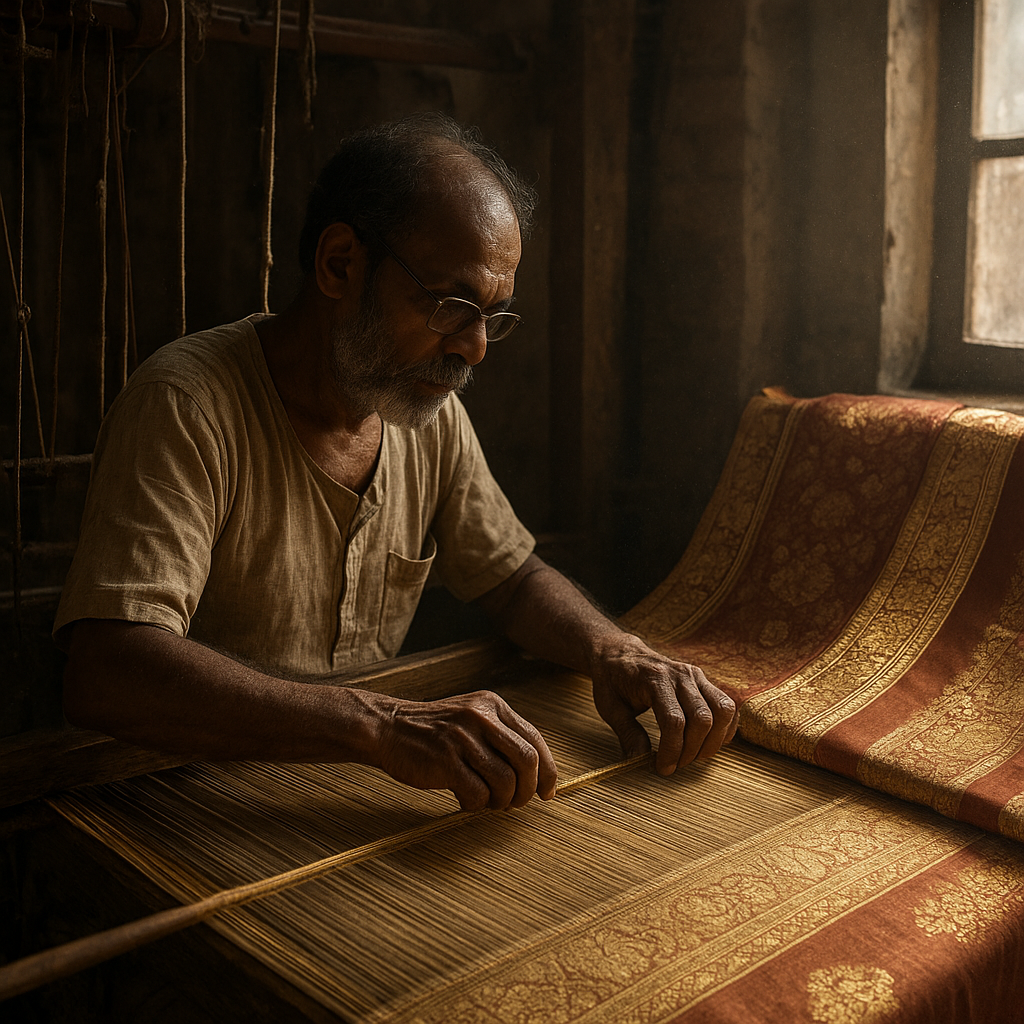
This is where the magic happens. The weaver receives the silk yarn and zari, prepares the loom, and begins the painstaking process of hand-weaving the saree.
Preparing the Loom (1 to 2 days)
The weaver (or an assistant called a warp wala) strings the warp — the longitudinal threads that run the length of the saree. For a standard Banarasi saree, this means stringing 5,000 to 7,000 individual silk threads onto the loom, each one threaded through a heddle (the mechanism that raises and lowers the threads). This takes one to two full days.
Weaving (3 to 60 days)
The actual weaving happens on a pit loom or frame loom. The weaver sits at the loom and operates the shuttle (which carries the weft thread) with one hand while operating the heddles with the other. The zari is woven in using a technique called brocade weaving — the zari thread is introduced only where the motif appears, not across the full width of the fabric.
A skilled weaver produces 3 to 15 inches of fabric per day, depending on the complexity of the design. A simple butta saree takes 3 to 5 days. A full jall bridal piece takes 30 to 60 days.
Finishing (1 day)
Once the weaving is complete, the saree is cut from the loom. The raw edges are finished, the fall (a cotton tape stitched to the hem) is attached, and the saree is pressed and folded. The weaver or his family inspects the piece for defects — a single broken thread or missed motif can mean unraveling hours of work.
Stage 5: Quality Control and Photography (Surat)
At Nisa Silk Fab, every saree travels from Varanasi to our facility in Surat for quality control:
- Inspection: Each saree is inspected under bright light for defects — broken threads, color inconsistencies, zari irregularities, weaving errors.
- Silk Mark verification: For sarees above Rs 2,000, we verify that the fabric passes the burn test and apply for Silk Mark certification.
- Photography: Every saree is photographed in natural daylight (not studio lighting) so the online image matches the real product. We shoot the full drape, the pallu detail, the border, and the reverse.
- Packaging: The saree is folded in acid-free tissue paper, placed in a muslin cloth bag (not plastic), and packed with a care card and authenticity certificate.
Stage 6: Your Doorstep
The saree ships from Surat via Blue Dart or Delhivery. Domestic shipping takes 2 to 4 days. International shipping takes 7 to 14 days. Every order includes:
- The saree in a muslin bag
- Silk Mark certificate (if applicable)
- Care card with washing and storage instructions
- A handwritten note from the weaver (for premium pieces)
The Full Journey: A Summary
| Stage | Location | Time | Hands |
|---|---|---|---|
| Silk cocoon | Karnataka | 30 days (silk worm lifecycle) | Silk farmer |
| Yarn processing | Surat / Varanasi | 3 to 5 days | Yarn processor |
| Zari manufacturing | Surat | 2 to 3 days | Zari maker |
| Weaving | Varanasi | 3 to 60 days | Master weaver |
| Quality control | Surat | 1 day | QC inspector |
| Photography + packaging | Surat | 1 day | Photographer + packer |
| Shipping | Surat to you | 2 to 14 days | Courier |
| Total | 2,000+ km | 40 to 100+ days | 6+ people |
Why This Matters
When you buy a Banarasi saree for Rs 4,200, you are not paying for a piece of fabric. You are paying for:
- 30 days of silkworm cultivation in Karnataka
- 3 days of yarn processing in Surat
- 2 days of zari manufacturing in Surat
- 10 days of weaving in Varanasi
- 1 day of quality control and photography in Surat
- The accumulated knowledge of a weaver family spanning four generations
The saree in your cupboard is not a product. It is a supply chain. It is a community. It is the reason forty weaver families in Varanasi can send their children to school. When you buy handloom, you are not just buying silk. You are keeping a 500-year-old supply chain alive.
Frequently Asked Questions
How long does it take to make a Banarasi saree?
From silk cocoon to finished product: 40 to 100+ days. The weaving itself takes 3 to 60 days depending on complexity. The rest is raw material processing, quality control, and shipping.
Why does the zari come from Surat, not Varanasi?
Surat has been the center of zari manufacturing for over 300 years. The copper wire drawing, silver coating, and gold plating processes require specialized infrastructure that exists only in Surat. Varanasi weavers buy zari from Surat suppliers.
How can I trace my saree’s journey?
At Nisa Silk Fab, we provide the weaver’s name, the weave time, and the silk and zari grades on every product page. Ask us about any saree — we will tell you exactly who made it and how long it took.
Is the supply chain the same for all Banarasi sarees?
No. Factory-produced (power-loom) sarees skip the handloom stage entirely and use cheaper zari. Art silk sarees use synthetic yarn instead of real silk. The journey described above applies only to genuine handloom Banarasi silk sarees.
Every saree at Nisa Silk Fab is traceable to the weaver who made it. Browse our collection or read more about our direct-to-weaver model.