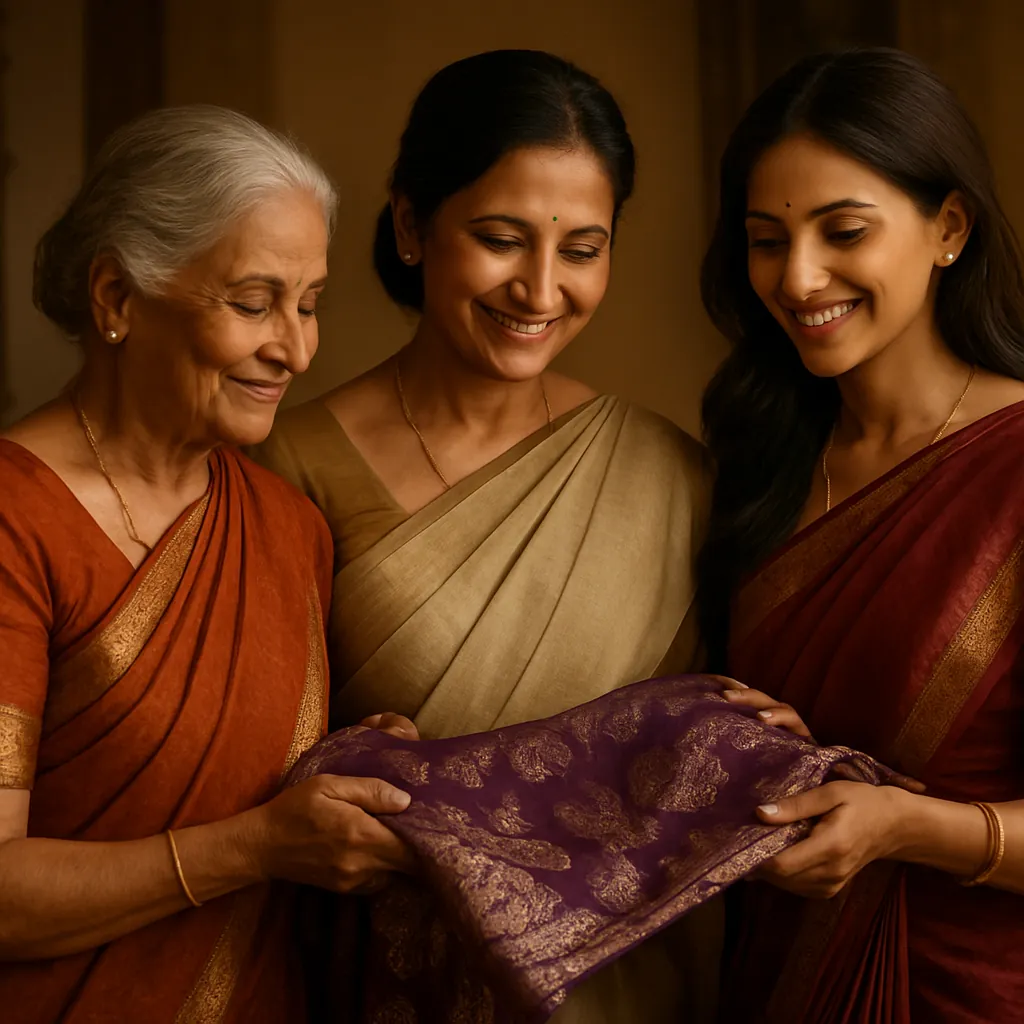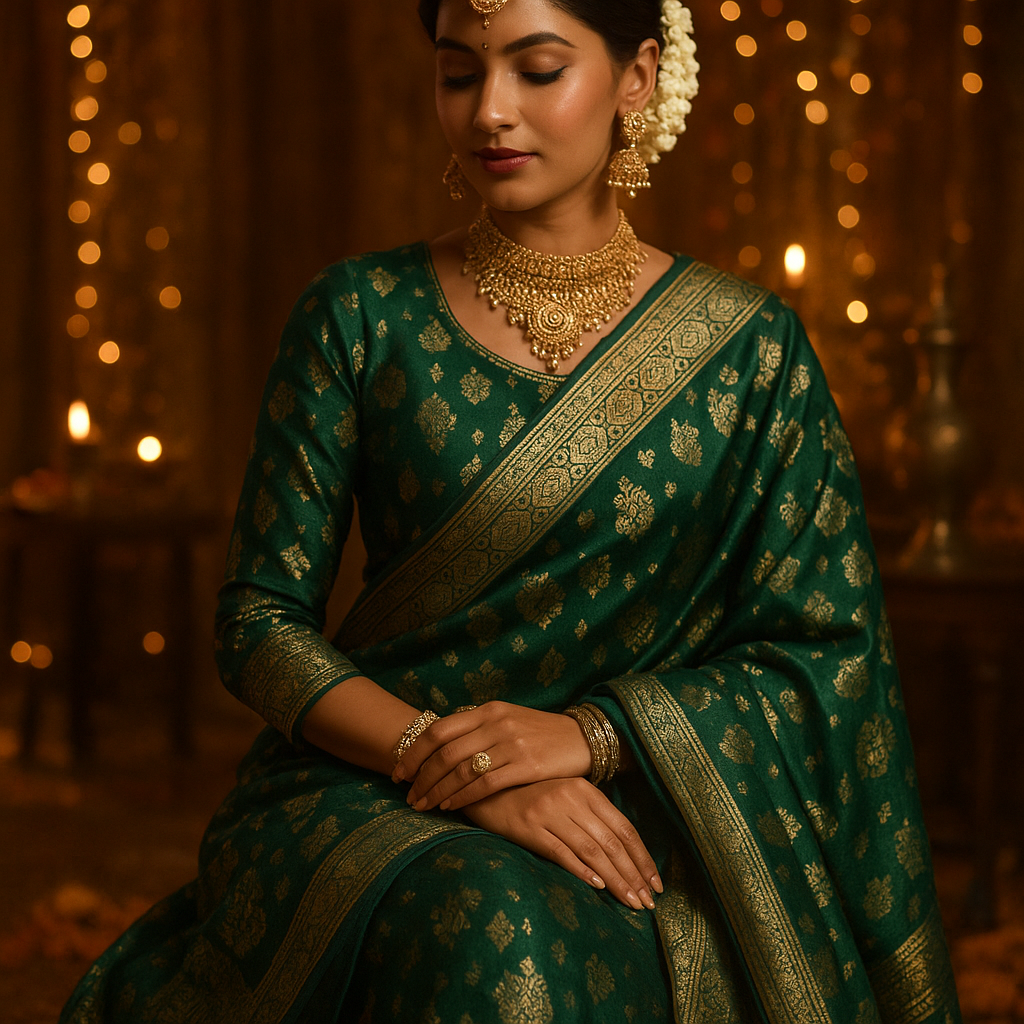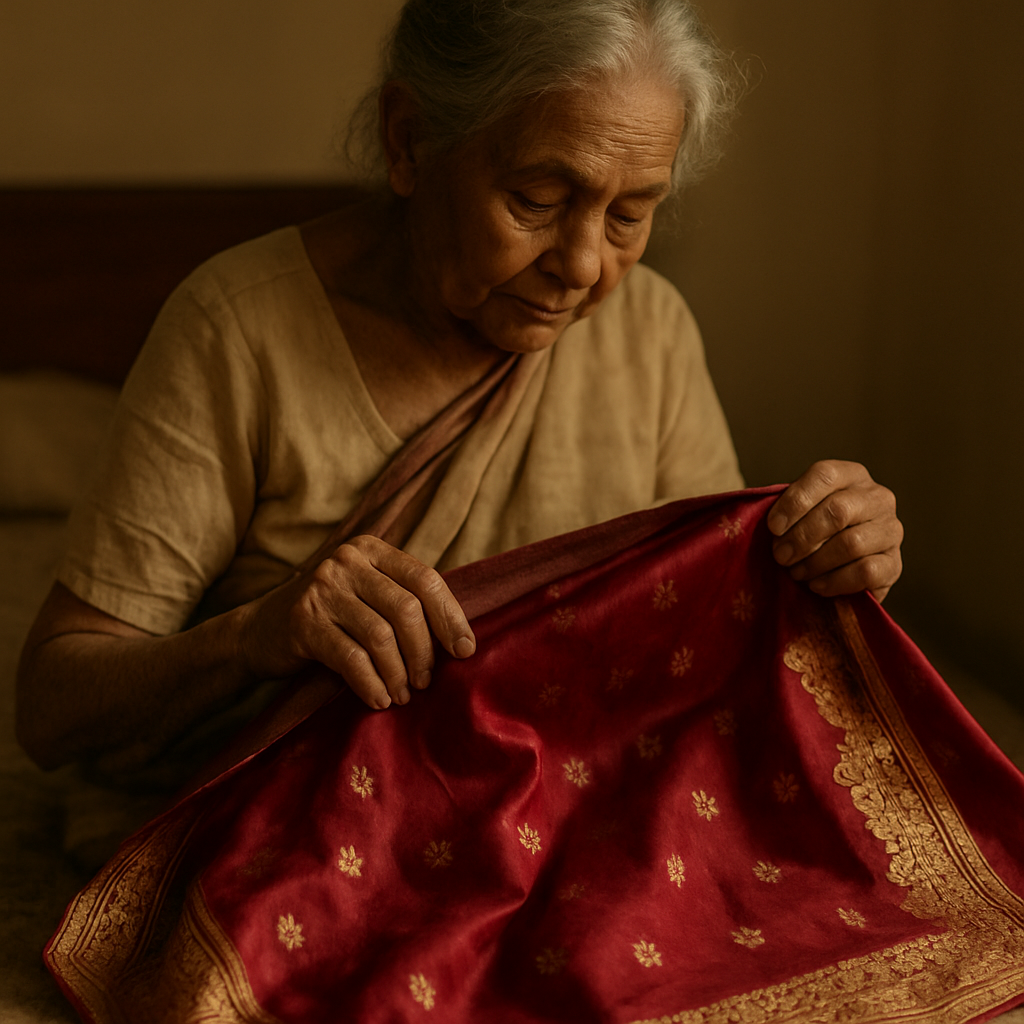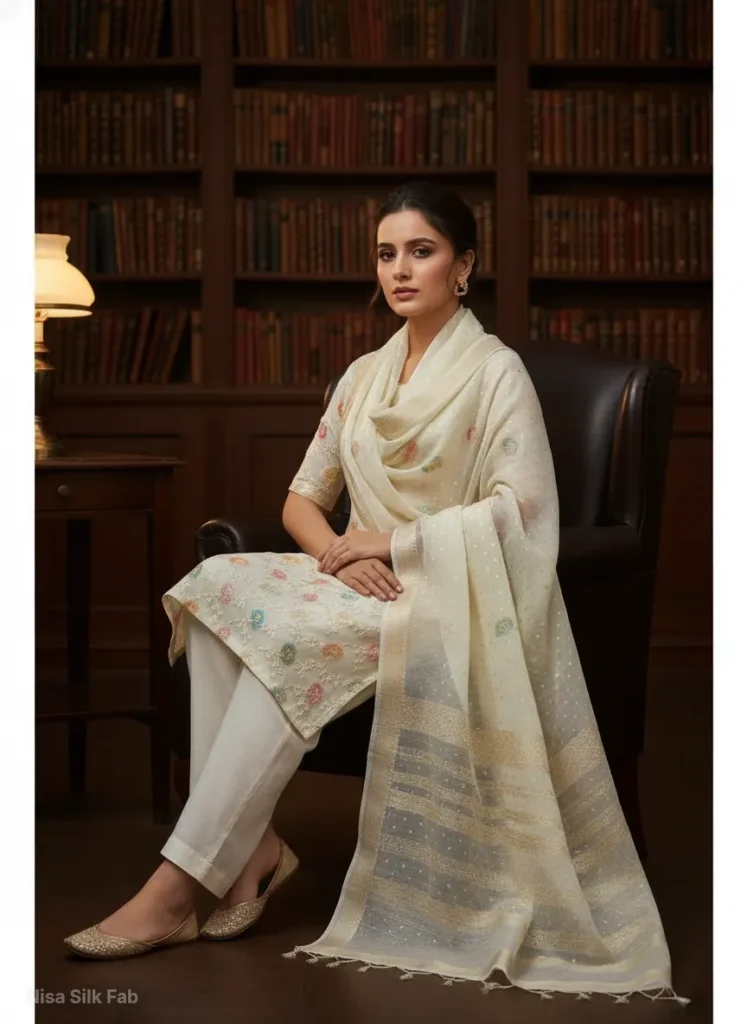
The invitation says the wedding begins at dawn. By the time you reach the guest room in your sister’s house in Ahmedabad, the sky is already grey with the promise of rain. Two sarees are spread across the bed. One is a cream Banarasi with small gold butis scattered like seeds across the body and a narrow bel border. The other is a maroon Kanjivaram with a wide temple border that repeats in red and gold, the kind of border that looks like the edge of a temple tower.
You are the mother of the bride. You will be on your feet from the first ritual to the last photograph. You run your hand over each fabric. The Banarasi feels soft and yields under your fingers. The Kanjivaram resists slightly, dense and certain. You are not asking which saree is better. You are asking which silk saree for a wedding guest—or in your case, for a mother—will let you move, sit, and stand through a long day without thinking about the cloth at all.
Origins and Heritage
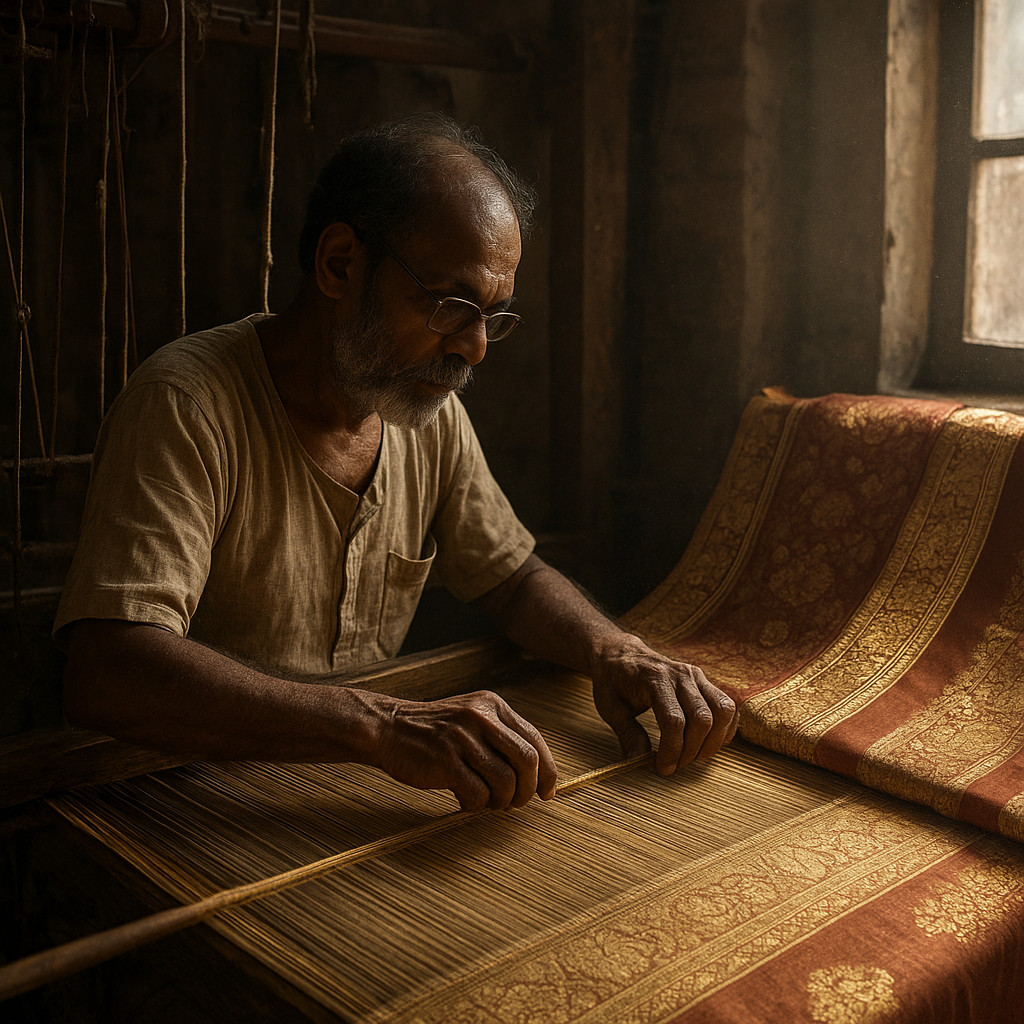
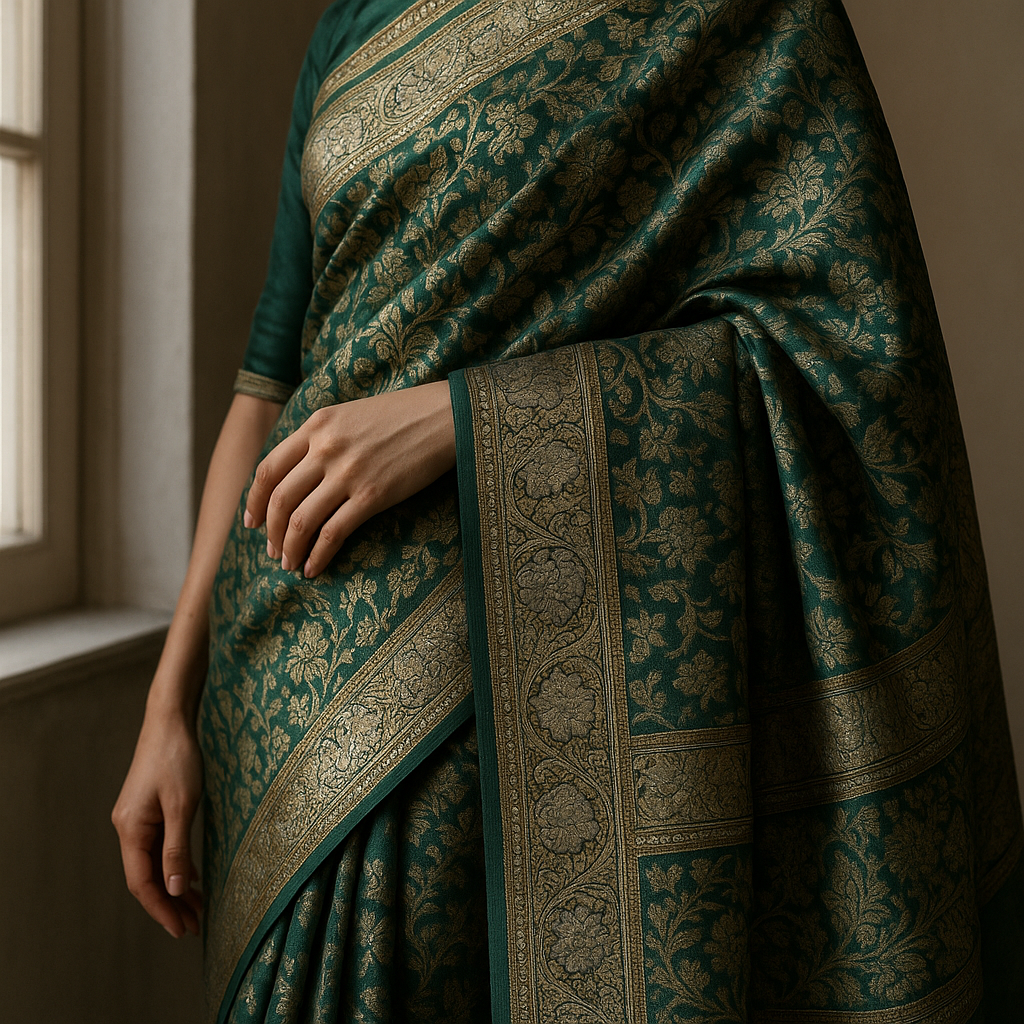
Banarasi sarees come from Varanasi, also called Banaras, on the banks of the Ganges. The weaving tradition there is tied to the pit-loom, where the weaver sits at ground level and works the treadles with their feet. Over centuries, the designs absorbed Mughal influences. You will see fine floral butis, climbing bel patterns, dense jangla work that covers the body like a garden, and kalka or paisley motifs that curve like a teardrop. The aesthetic is intricate, almost jewel-like, and the motifs often look as if they are embroidered, though they are woven.
Kanjivaram sarees come from Kanchipuram, a temple town in Tamil Nadu. The tradition is linked to the temple economy and to weaving communities that settled there to serve pilgrims and royalty. The designs are architectural: temple borders that repeat like the gopuram of a South Indian temple, checks, stripes, and broad contrasting borders. A defining technical feature is the Korvai weave, where the border and the body are woven separately and then interlocked. The join is visible as a firm line where the two parts meet.
Silk and Weave
Both traditions use pure silk, but the feel on the skin is different.
Banarasi silk is often woven with extra-weft techniques. The motif is not printed or embroidered; it is created by adding extra threads of zari or silk into the weft as the saree is woven. This gives the design a raised, floating appearance on the surface. Depending on the variety, the base may be katan, organza, georgette or pure silk, and each behaves differently. katan vs organza guide
The Kanjivaram vs Banarasi silk difference is most obvious in the yarn. Kanchipuram weavers traditionally use mulberry silk that is heavier and more tightly twisted. The yarn is thick, and the weave is dense. The result is a saree that holds its shape, with a body that does not collapse easily. It is a sturdier textile, built to last through generations if stored well.
Zari and Lustre
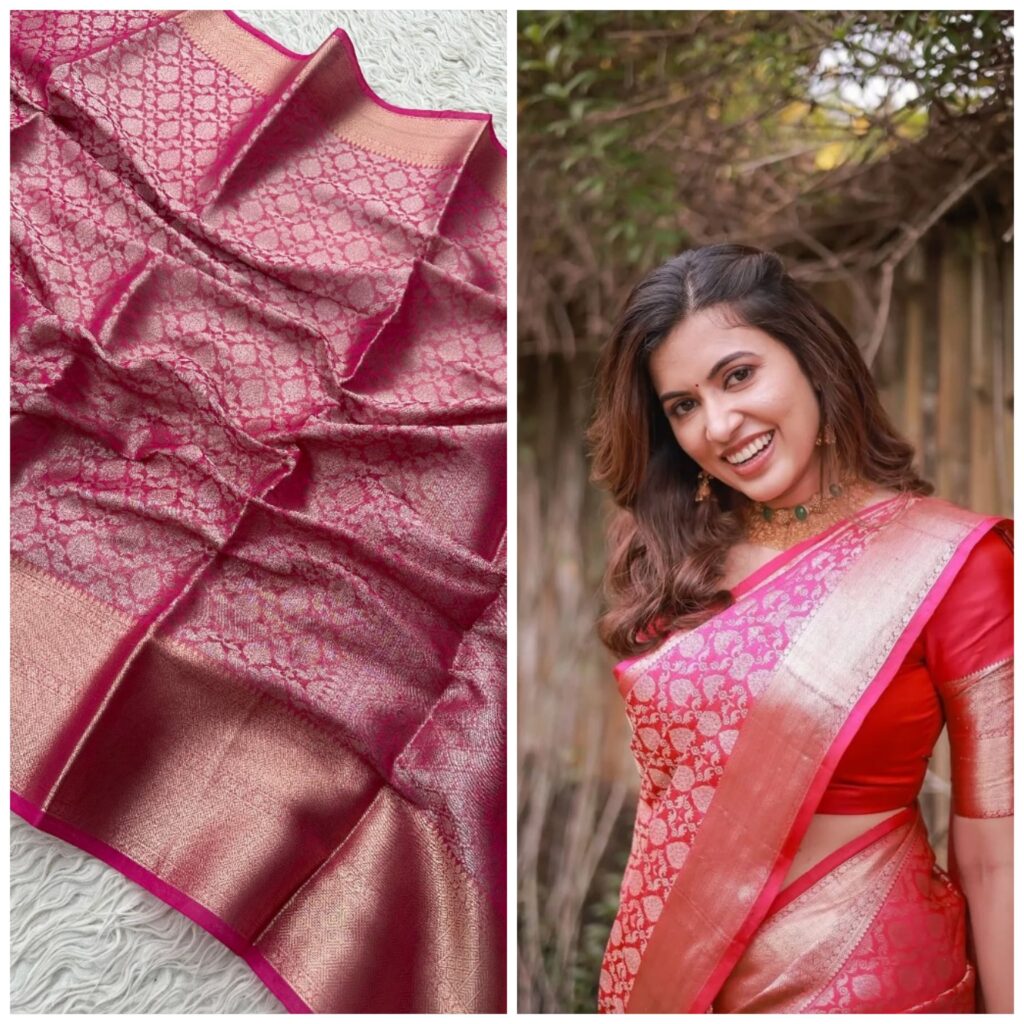
The zari in a Banarasi saree is traditionally made from silver thread that is gold-plated and wound around a silk core. The lustre is soft, gentle, almost like moonlight on water. It shimmers without shouting. This suits the fine, detailed motifs where too much brightness would overwhelm the design.
Kanjivaram zari is worked bolder and heavier, so it reads more prominently on the border. When light falls on a Kanjivaram border, the zari reflects it strongly. The effect is regal and celebratory, which is why the saree is often chosen for the most important person at a wedding.
Drape, Weight and Comfort
If you are attending a wedding that runs from morning prayers to a late reception, comfort matters. Banarasi sarees are generally lighter and easier to carry. The fabric breathes, the pleats fall softly, and you can move through a crowded hall without feeling weighed down. It is a practical choice for a guest or a mother who will be on her feet for hours.
Kanjivaram sarees are heavier. The drape is structured and the fall is firm. This weight is part of the appeal for a bride or for a grand occasion where you want the saree to hold a particular silhouette. But if you are not used to carrying six yards of dense silk, it can feel tiring by the end of the day.
Look and Occasion
Choose a Banarasi saree when you want intricate detail. The jewel-like motifs work beautifully for festive evenings, pre-wedding functions, and receptions. It is a natural choice for a wedding guest, a mother of the bride or groom, or anyone who wants to look dressed up without looking like the bride.
Choose a Kanjivaram saree when you want bold borders and temple motifs. It is the classic bridal silk of South India, and it suits grand occasions where tradition and presence are the priority. The strong contrast between body and border makes a statement even in a large gathering.
If you are deciding between Banarasi vs Kanjivaram for wedding wear, think about the role you will play. A guest rarely needs the formality of a heavy bridal drape, while a bride often wants the weight and presence that a Kanjivaram provides.
How to Check Authenticity
Whether you are buying Banarasi or Kanjivaram, a few general checks can help you avoid machine-made imitations.
Silk Mark is a certification that confirms the fabric is pure silk. It does not certify that the saree is handloom, so a Silk Mark label alone does not guarantee a handwoven piece.
GI tags tie each name to its place of origin. A Banarasi saree with a GI tag is linked to the Varanasi region, and a Kanjivaram with a GI tag is linked to Kanchipuram. These tags protect the identity of the weave, but they are only one part of the picture.
Look at the reverse side. In a handwoven saree, the motifs on the back are often visible as loose threads or a clean mirror of the front, depending on the weave. Power-loom imitations usually have a flat, uniform back with no sign of extra weft.
Price sanity matters too. A genuine handloom pure-silk saree involves days or weeks of work at the loom. It cannot be sold for a few hundred rupees. If the price seems too low to cover the silk and the weaver’s time, it probably is not a genuine handloom piece. For a general sense of what handwoven Banarasi sarees typically cost, see our Banarasi saree price guide. If you want to learn how to tell an original Banarasi from a copy, our identify original Banarasi guide explains the markers in detail.
Comparison at a Glance
| Feature | Banarasi Saree | Kanjivaram Saree |
|---|---|---|
| Origin | Varanasi (Banaras), Uttar Pradesh | Kanchipuram, Tamil Nadu |
| Loom tradition | Pit-loom | Temple-town weaving with Korvai |
| Key motifs | Butis, bel, jangla, kalka | Temple borders, checks, stripes |
| Silk feel | Lighter, extra-weft motifs | Heavier mulberry silk, dense weave |
| Zari | Silver, gold-plated, soft lustre | Worked bold and heavy, prominent |
| Drape | Soft, easy for long hours | Structured, firm fall |
| Best suited to | Guests, mothers, festive evenings | Brides, grand occasions |
| Authenticity markers | Silk Mark, GI tag, reverse weave | Silk Mark, GI tag, Korvai join |
Which One Should You Choose?
There is no wrong answer, only the right answer for the role you are playing at the wedding.
If you are a guest, choose a Banarasi saree in a colour that complements the wedding palette without competing with the bride. The lighter weight means you can sit through ceremonies, greet people, and still feel comfortable at dinner. shop Banarasi sarees
If you are the mother of the bride or groom, a Banarasi saree gives you elegance and ease. You will be moving between venues, and a lighter silk will serve you better than a heavy one.
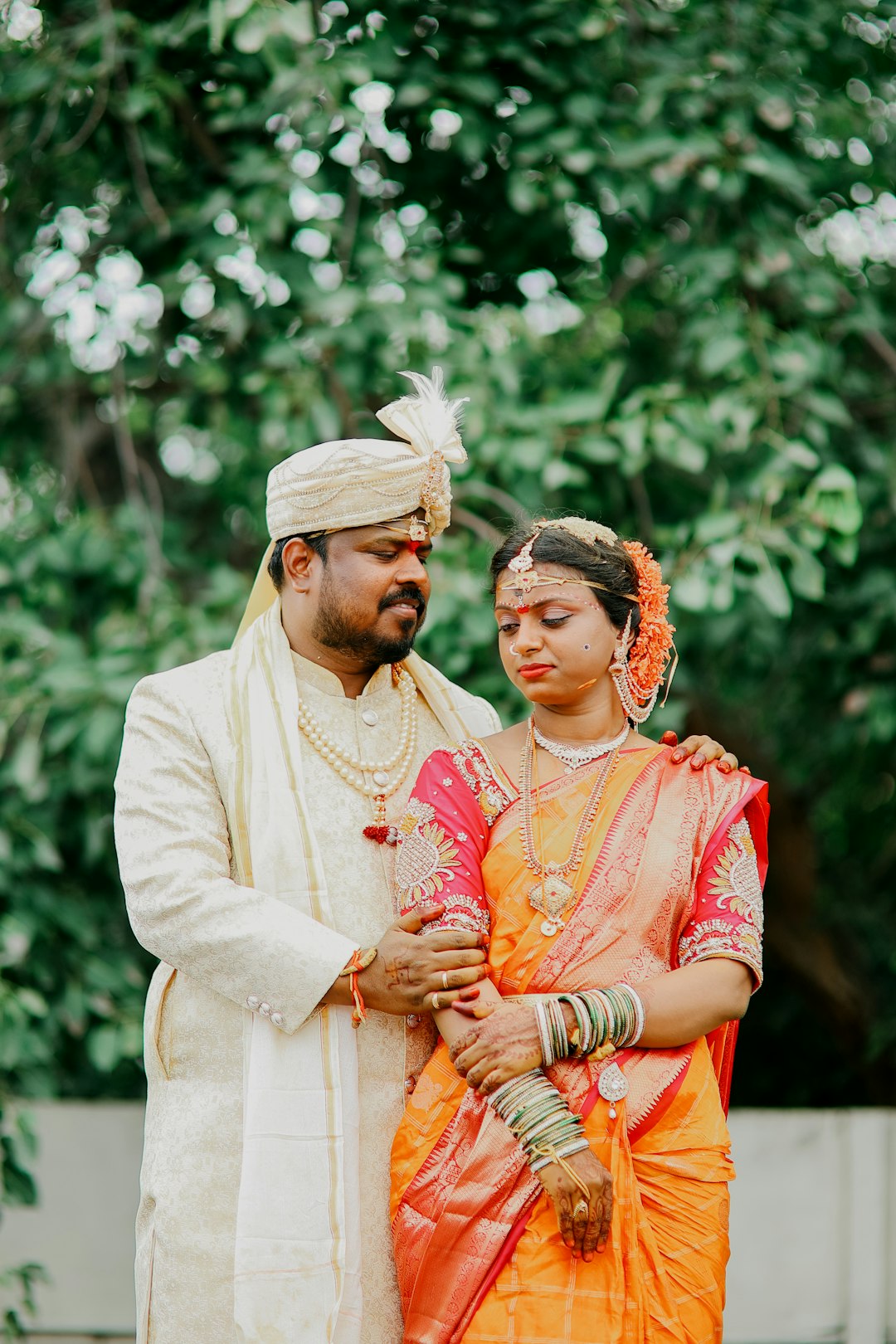
If you are the bride and the wedding follows South Indian traditions, a Kanjivaram saree is the natural choice. The bold border and heavy drape carry the formality of the occasion.
If you are torn between the two, think about how long you will be wearing it. For a long day with many events, the Banarasi is kinder to your shoulders. For a single grand ceremony where you want to make a strong visual statement, the Kanjivaram is hard to beat.
Remember that Nisa Silk Fab is based in Ahmedabad and sells handwoven Banarasi sarees. We do not sell Kanjivaram sarees. If your choice leans towards Banarasi, you are welcome to browse our collection of handwoven pieces.
FAQ
Can I wear a Banarasi saree to a South Indian wedding?
Yes. A Banarasi saree is appropriate for a wedding guest across regions. Choose colours and motifs that suit the formality of the event.
Is a Kanjivaram saree only for brides?
No. While it is a traditional bridal choice, Kanjivaram sarees are also worn by guests and family members at grand occasions. The weight and bold border make it best suited to formal events.
Does Silk Mark mean a saree is handwoven?
No. Silk Mark certifies that the silk is pure. It does not certify that the saree was woven on a handloom.
Which saree is easier to wear for a long ceremony?
Generally, a Banarasi saree is lighter and easier to carry through long ceremonies. A Kanjivaram is heavier and more structured.
Where can I buy handwoven Banarasi sarees?
You can browse the handwoven Banarasi collection at Nisa Silk Fab, an Ahmedabad-based seller. We do not sell Kanjivaram sarees.
Closing
Wedding season brings many decisions, and the choice of saree is one of the most personal. Whether you lean towards the intricate weave of Banaras or the bold border of Kanchipuram, pick the saree that makes you feel at ease.
Nisa Silk Fab sells handwoven Banarasi sarees from our base in Ahmedabad. We do not sell Kanjivaram sarees. If you choose Banarasi, you can explore our range online.
Standard delivery in India takes 7–14 business days. Shipping is a flat ₹100 across India. All sales are final, and we do not accept returns.